X-UMED | Dark History, Paranormal & Folklore

LAST UPDATED: NOVEMBER 9, 2026
googlemaps
Kecksburg / Mount Pleasant Township
Kecksburg UFO Incident of 1965
The Great Lakes fireball, the woods search and the story of the Space Acorn

On December 9, 1965, people around the Great Lakes saw a fireball bright enough to stop them in their tracks. In Kecksburg, Pennsylvania, some thought something had come down in the woods. Police, volunteers and a military team searched. The surviving Air Force record says they came up empty. The story told years later has a very different ending, with a bronze object, a cordon and a covered truck. The fireball and the search are documented. To see where the rest of the story comes from, you have to follow what people said in 1965 and what made it into print and onto television later.

A large acorn-shaped television replica displayed outdoors in Kecksburg
REGION

Southwestern Pennsylvania

ERA

1950–Present

ENVIRONMENT

Roadside commemorative display and regional fireball sighting

HISTORICAL BACKGROUND

A large acorn-shaped television replica displayed outdoors in Kecksburg
Kecksburg’s Space Acorn display

The fireball before it became a crash story

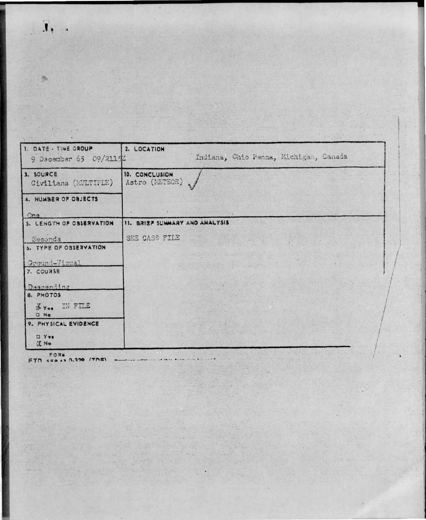
The light crossed a region much bigger than Westmoreland County. Witnesses around the Great Lakes and into Ontario reported a bright streak on December 9, late in the afternoon. The Air Force’s Project Blue Book case 10129 files reports from Indiana, Ohio, Pennsylvania, Michigan and Canada together. Some observers described a trail or flashes. In a fast event seen from a great distance, a bright object sinking toward the horizon can look as though it dropped behind the nearest ridge. People at different points on the ground can sincerely describe different directions. The question for investigators was whether those observations could be fitted to one path.

Astronomers Von Del Chamberlain and David J. Krause reconstructed the event in a 1967 paper in the Journal of the Royal Astronomical Society of Canada. Their work drew on photographs and reports from multiple observers. A photograph with a known location and direction helps anchor a line of sight. Combining observations from different places gives investigators a better way to estimate a trajectory than asking one person which patch of trees the light seemed to vanish behind. The Great Lakes reconstruction supports a meteor, with the path over the western Lake Erie area. That conclusion has a different basis from the conclusion that a particular patch of Pennsylvania woods held no object.

What the search paperwork says

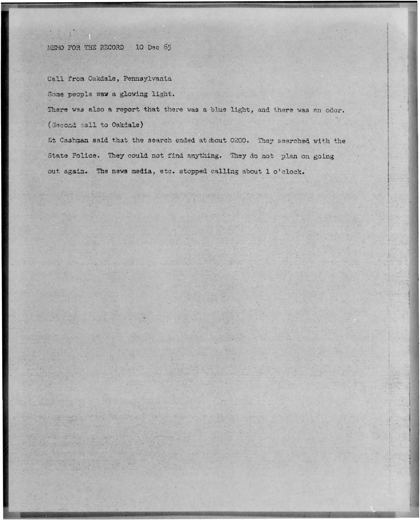
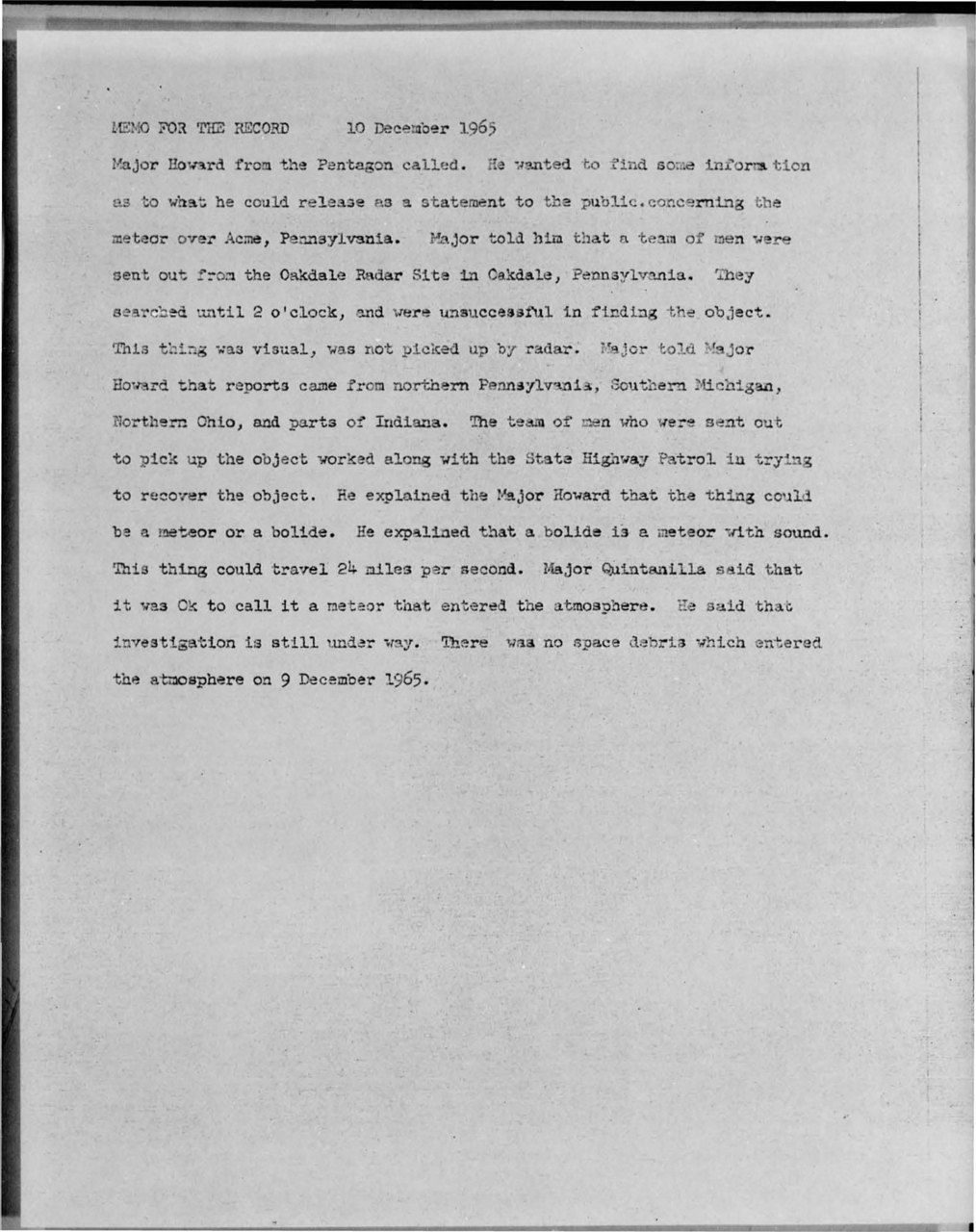
A report of something down near Kecksburg brought out local searchers and state police. Air Force records use Acme as well as Kecksburg for the area. The case file and chronology of its memoranda place a team from the Oakdale radar site in the search and record a report that nothing had been found by about 2 a.m. The December 10 memorandum about a Pentagon call says the object was reported visually and the Air Force had no radar pickup for it. It also says the team worked with state police in an attempt to recover an object. Read the assignment and the outcome together. A team sent to recover something was a team following up on a report. The same page says it returned without finding it. The final record card classifies the sky event as a meteor. That paperwork is important because a military search sometimes gets treated as a detail added later. The search is part of the contemporary record. The item in a truck is a separate claim.

In its first round of reporting, the Greensburg Tribune-Review ran a headline that spoke of an unidentified object falling and the Army roping off an area. Another headline said searchers found no object. The preserved newspaper leads and edition comparison show why reading only the front-page headline can give a misleading impression. A report about a search in progress can sound decisive. An updated headline can say what searchers reported finding while leaving the first reports of activity unexplained. Neither headline, by itself, gives the reader a photograph of a recovered object or a record of where it was taken.

STORY & LEGENDS

The story was still being argued before it reached national television

In the immediate aftermath, the news was a regional fireball and a local search. The later question was whether the searchers had found something the public had never seen. The 1986 Tribune-Review reporting preserved in a clipping service shows how researcher Stan Gordon used government records to reopen local discussion twenty years later. That is a dated point in the development of the recovery story. It leaves open when particular witnesses first told their accounts privately or when every feature of the acorn story took its present form.

By 1990 the TV version was controversial in Kecksburg itself. United Press International reported residents’ objections while the production was being made. Some people who lived nearby rejected the idea of a crash and recovery, while others thought important pieces of the story had never been told. The disagreement matters because it puts local dissent on the record during the same period that the recovered-object version gained its largest audience. It is hard to call the recovery story a single community memory when people from the community were publicly contesting it.

ORIGIN STORY

The bronze acorn, the writing and the truck

In the familiar Kecksburg story, a metallic object the size of a small car comes down in the woods. It has a broad end that some people compare to the cap of an acorn, with a band of markings. Military personnel get there, clear people out and carry the object away under a covering. The Unsolved Mysteries account gave those details a national audience in 1990. A model built for the production later became Kecksburg’s roadside Space Acorn. Once you have seen that shape on television or standing beside a road, it is easy to carry it backward in your mind and imagine that the first newspapers printed a picture of it.

The acorn story contains several claims that would require different kinds of corroboration. A witness who says they stood near a shaped object has a different vantage point from a witness who describes a covered truck on the road. A tarp hides its load, even if the truck and the tarp were both there. A witness who heard that others had been sent away may have learned something about who controlled access, while knowing nothing about what happened inside. The legend stitches those views together into one sequence. The surviving records give us no continuous record linking them.

ALTERNATE VERSIONS

A Soviet probe came down the same day

The Soviet spacecraft Kosmos 96 really did return to Earth’s atmosphere on December 9. It had been launched on November 23 in a failed attempt to send a probe toward Venus. NASA’s released records include a catalog reference with both dates. Same date is a good reason to check the theory. The next questions are time and ground track. In Leonard David’s reporting on the orbital evidence, NASA orbital-debris specialist Nicholas Johnson explains why the probe’s orbital constraints make a Pennsylvania fall at the reported time a poor fit. A failed spacecraft and a regional fireball can share a calendar date without being the same event.

A second possibility is that smaller natural fragments fell somewhere along the meteor’s path. The Air Force file includes reports of material elsewhere in the region, including flat pieces reported in Michigan. A regional fragment report needs its own proof of origin. It does not establish that a large object reached the woods at Kecksburg. In the case chronology, one Air Force call even raises ordinary radar chaff as a possibility for a reported material. A file that collects leads will contain things the investigators considered without necessarily confirming them.

WITNESS ACCOUNTS

What people said they saw

Jim Romansky’s later account is among the best-known. He described seeing the object on the ground and remembered markings near its base. Stan Gordon’s collected accounts also include accounts of people who thought they saw the object descend, go toward the woods, or get hauled away. Some of those people claimed firsthand sight of a specific part of the sequence. The later interviews are the evidence for what they remembered. They do not turn each element into a sighting recorded that night.

The television program also put different kinds of witnesses next to one another. Robb Landy remembered seeing the light while out with his brother Ray. Nevin and Nadine Kalp supplied a version in which the thing appeared to come down in a wooded ravine. Romansky described going out with the search and seeing something on the ground. These accounts from the program’s published reconstruction describe different stages of the alleged event. None independently tracks the light from the sky all the way to the load on a truck.

Ed Myers, identified as Kecksburg’s fire chief at the time, gave a conflicting account. He said he searched the woods and saw nothing. The comparison of the witness accounts and the Air Force records traces his words to later reporting, rather than to a signed statement written on the night. His experience does not settle what was in every part of the woods. It matters because it comes from someone who says he spent time in the search area and reached a different conclusion. WTAE’s 60-year follow-up shows how those accounts remained part of the local conversation.

The reported markings add another problem. Comparing writing to hieroglyphs tells you what it looked like to someone who could not read it. It supplies no text to compare with Cyrillic lettering, manufacturing marks or anything else. The TV prop is what the producers made from the story. It gives us a record of how they pictured the marks, while an original photograph or contemporaneous drawing would be needed to check what a witness actually saw.

MORBID FACTS

How a reporter’s death became part of the story

John Murphy, who worked at Greensburg radio station WHJB, became a character in the later accounts. The later witness record assembled from accounts of Murphy and his colleagues connects him with reporting on the woods search and a radio program that others later described as altered or missing material. In the familiar telling, people came to the station and the broadcast changed. The surviving retellings relay accounts from colleagues and participants years afterward. An intact before-and-after recording, station logs or a written order would let us test the specific claim that someone forced him to change it. The public materials reviewed here do not provide that chain.

The local marker record says Murphy died in a California hit-and-run in 1969 and repeats the story of his missing information. The marker records what is publicly commemorated in Kecksburg today. It does not supply the original police file or show a causal link between the death and his radio work four years earlier. The version in which Murphy was silenced depends on joining together separate events, each with a different set of surviving sources. His death is worth treating carefully without making it proof of what happened in the woods.

The missing government files were a real dispute

In 2003 journalist Leslie Kean asked NASA for Kecksburg-related records. The public messages that followed added confusion. A 2005 NASA spokesman’s statement reported in the press referred to examination of fragments and misplaced records. The later orbital assessment ruled out the specific Kosmos 96 explanation. The two reports have often been fused into a claim that a known Soviet vehicle was retrieved from the woods. The statement reported in 2005 did not supply a dated lab report, specimen number or a route from Kecksburg to a laboratory. The federal court’s March 2007 opinion describes an agency search, the questions Kean raised about its adequacy and why the court would not simply accept NASA’s showing at that stage. The later NASA records release on the lawsuit preserves the trail of requests, declarations and follow-up over records including missing files about recovered fragments. A records gap is something researchers can document. It leaves a gap in what we can reconstruct. It does not establish that a particular object was recovered, what it was made of, or why papers became unavailable.

CURRENT DAY

WHAT WE CAN VERIFY

Confirmed History

  • A regional fireball and an official search near Kecksburg and Acme are documented. The Air Force file records a negative search result and classifies the sky event as a meteor.

Unverified Claims

  • No authenticated photograph, artifact, transfer record or other traceable evidence verifies removal of an acorn-shaped object. A connection between John Murphy’s reported death and his work remains unsubstantiated.

Important

  • The acorn and flatbed accounts were publicized later. NASA records litigation concerned how the agency searched for records, and the Kosmos 96 orbital evidence is a poor fit.

HISTORICAL PHOTO GALLERY

A CLOSER LOOK THROUGH THE YEARS

KEEP EXPLORING

MORE STORIES FROM X-UMED'S DARK ARCHIVE

X-UMED EPISODE/VIDEO

Leave a Reply

CATEGORIES

UFO/Unexplained
googlemaps

LOCATION & ACCESS

googlemaps
Kecksburg / Mount Pleasant Township
REGOIN
Southwestern Pennsylvania
COORDINATES
40.18617
-79.46298
ADDRESS
Space Acorn display near the Kecksburg Volunteer Fire Department, 5128 Water Street, Kecksburg, Westmoreland County, Pennsylvania.
ACCESS
Open to Public
LOCATION ON MAP
HELP US DIG DEEPER

have a firsthand account, an old photo, or a correction about this place?

SHARE THIS STORY
X
Reddit
Threads
WhatsApp
Email
StumbleUpon
Facebook
SEARCH THE DARK ARCHIVE
148STORIES
UNEARTHED
358MORE STILL
BURIED
29% OF THE ARCHIVE UNEARTHED