
 Dark ArchiveHart Island and New York City’s Potter’s FieldBurial labor, missing ledgers and the fight to visit the gravesVIEW ARCHIVE →
LAST UPDATED: NOVEMBER 14, 2026
Petersen House: The Room Where Lincoln Died
On the night of April 14, 1865, the Petersen boarding house across from Ford’s Theatre became an improvised emergency treatment site after President Abraham Lincoln was shot. Carried into a small rear bedroom, Lincoln remained unconscious as doctors attended him and government officials gathered nearby. He died there at 7:22 the next morning.
The house belonged to William and Anna Petersen, whose ordinary boarding business was suddenly overtaken by a national tragedy. The death room became an object of public fascination, and visitors later took pieces of its furnishings and interior as souvenirs. The story of Petersen House is also the story of the residents and boarders whose private home became a permanent part of American history.

REGION
Petersen House
ERA
1800s
ENVIRONMENT
Building
HISTORICAL BACKGROUND
History: The Petersens and their boarding house
William and Anna Petersen were German immigrants who built the house around 1849. They lived with their family in the lower part of the building and rented rooms upstairs. Boarding houses were common in Civil War Washington: the city’s population swelled as soldiers, clerks, contractors, and officials arrived. The Petersen home was part of that ordinary urban economy, not a mansion reserved for dignitaries. By April 1865, approximately 13 to 15 people lived there, although the exact count and who was home that night vary by reconstruction.
The occupant of the room where Lincoln would die was William T. “Willie” Clark, a War Department clerk from Massachusetts. He was out celebrating the end of the war when the president was carried into his bedroom. Another boarder, Henry Safford, a young War Department employee, heard the commotion outside and offered the house as a place to bring the injured president.
April 14: The president arrives
Lincoln was shot at Ford’s Theatre at approximately 10:15 p.m. Dr. Charles Leale and other attendants judged that he needed immediate care and could not withstand a long journey. Men carried the unconscious president across 10th Street. Safford called to them from the Petersen House, and Lincoln was taken through the entrance and down the hall into a small rear bedroom. The president stood six feet four inches tall; the bed was too short for him to lie straight, so he was positioned diagonally across it.
The injury was catastrophic. The bullet had entered Lincoln’s head, and he never recovered consciousness. Physicians monitored his breathing and condition through the night, but nineteenth-century medicine offered no effective way to reverse the damage. The oft-repeated notion that Lincoln made a final speech from this bed is untrue. His last reported spoken words had been at the theater before the attack.
A house divided between grief and government
The three main-floor rooms served different purposes. In the rear bedroom, physicians attended Lincoln. In the front parlor, Mary Lincoln spent much of the night in anguish, supported by friends and her eldest son, Robert Todd Lincoln, who was summoned from the White House. Clara Harris, who had been with the Lincolns at the theater, also stayed near Mary after her fiancé Henry Rathbone was taken for treatment of his serious knife wound.
The back parlor became a working space for Secretary of War Edwin M. Stanton. While Lincoln was dying, Stanton questioned witnesses, sent instructions, helped organize the search for Booth and his collaborators, and coordinated the immediate response to the attack. In other words, a rented Washington bedroom and two ordinary parlors briefly became the emotional and administrative center of a national crisis. More than 90 people reportedly passed through the house during the night, according to the National Park Service’s site history.
Mary Lincoln’s confidante Elizabeth Keckley, a formerly enslaved woman who became a successful dressmaker, was not at the bedside that night. Mary sent for her, but messengers did not locate her. Keckley went to the White House after hearing the news and was not admitted; she later comforted Mary there. This detail is important because dramatizations often simplify who was present and when.
April 15: Death at 7:22 a.m.
Lincoln died at 7:22 a.m. on Saturday, April 15, 1865, at age 56. Stanton is traditionally credited with the words “Now he belongs to the ages,” though recollections of the precise wording differ. A simple pine coffin was brought to the house later that morning, and Lincoln’s body was taken back to the White House. The body was subsequently prepared for funeral observances, followed by the elaborate mourning and funeral train journey to Springfield, Illinois.
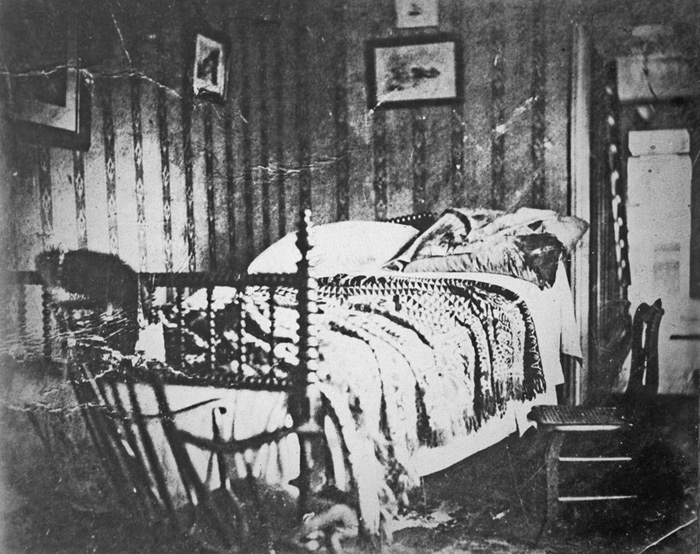
The room did not remain frozen in time. Boarders Henry and Julius Ulke, who lived upstairs and operated as photographers and artists, were allowed to enter after the body was removed. They photographed the room and bed, leaving rare contemporary visual evidence. Those photographs should be distinguished from later engravings showing Lincoln surrounded by numerous officials, which often combine people and moments for dramatic effect.
Aftermath: From boarding house to memorial
In the years after 1865, the house became a destination for people wanting to see the place where Lincoln died. The Petersens’ heirs eventually sold the property. The building was used for other purposes, including offices, before Lincoln collector Osborn Oldroyd’s museum occupied it in the 1890s. The federal government purchased the house in 1896. It later came under National Park Service stewardship.
The building’s preservation is not the same as perfect preservation of its contents. The preservation of the building did not guarantee the preservation of every original furnishing or finish; the later museum interpretation must be distinguished from the surviving 1865 structure.
The household that lost its privacy overnight
The Petersens were German immigrants who built the house around 1849 and ran it as a boarding house. Their family lived in the basement, while boarders occupied rooms above. Washington’s population had expanded during the Civil War, making rented rooms valuable. The house was a working family business before it became a national shrine.
When Lincoln was brought across 10th Street, William Petersen was not presiding over the house. The National Park Service reports that he remained at his tailoring shop for much of the evening and visited briefly; Anna Petersen was in New York with family. Their 15-year-old son Fred helped manage the crisis at home. The household was suddenly filled with physicians, officials, mourners, and guards.
Who actually lived in the death room?
The small rear bedroom belonged to boarder William T. “Willie” Clark, a War Department clerk. Clark was out celebrating the end of the war when Lincoln was brought in. According to the National Park Service, he returned after the president died and, exhausted, slept in the blood-stained bedding. This detail illustrates how violently a national event intruded into the private lives of ordinary tenants.
A death room turned into a souvenir market
The public descended on the house after Lincoln’s death. Curious visitors asked to see the room and took physical souvenirs. The National Park Service documents people cutting away pieces of carpet and wallpaper. By 1870, the once-busy boarding house had only two boarders recorded. William Petersen died in 1871 after an overdose of laudanum; Anna died four months later. Their deaths are documented, but the claim that the assassination supernaturally cursed them is not.
The house after the Petersens
The heirs later sold the property. The Schade family used it as a home, and children played in the room where Lincoln died. Osborn Oldroyd later operated a Lincoln museum in the house, which opened to the public in 1893. The federal government bought the property in 1896. The building was subsequently interpreted as part of Ford’s Theatre National Historic Site.
STORY & LEGENDS
From boarding room to shrine
The transformation began on April 15, 1865. A room used by a government clerk became the site of a president’s death, and crowds immediately treated it as a place of national pilgrimage. Souvenir taking, illustrated newspaper depictions, and museum displays helped establish the house’s symbolic reputation. None of those developments proves that the house is haunted.
The earliest independently locatable account of a specific apparition remains unverified in the sources reviewed. That research gap should not be filled with an invented date or witness.
ORIGIN STORY
The room that could not return to ordinary life
The central story is not a confirmed haunting but the transformation of a private rented room into a national death chamber. Visitors came looking for contact with the place where Lincoln had taken his last breath. Physical souvenirs were removed from the wallpaper and carpet. The room’s notoriety damaged the boarding-house business and reshaped the lives of its owners and tenants.
A house linked to misfortune
Later stories sometimes connect the Petersens’ financial decline and deaths to a curse associated with Lincoln’s murder. The underlying events are real, but the National Park Service documents ordinary historical causes and circumstances: relentless visitors, the loss of tenants, business difficulties, and William Petersen’s fatal laudanum overdose. A supernatural explanation is not established.
Ghost stories and missing provenance
The Petersen House is often grouped with Ford’s Theatre in paranormal tourism. Yet the reviewed institutional histories do not supply a verifiable first dated haunting report with a named witness and independent corroboration. This distinction should remain visible rather than presenting an unattributed legend as testimony.
The Crowded Deathbed Scene That Could Not Have Happened
Popular engravings of Lincoln’s last moments gather a huge assembly of generals, politicians, and mourners around the small bed. The National Park Service notes that the room could not physically have held the forty to sixty people shown in some illustrations. Artists were depicting the people who visited during the night as if they had all been present at once. The result became an enduring visual legend: a powerful image of national mourning that should not be mistaken for a literal snapshot of the room at 7:22 a.m.
The Room That Became a Shrine
The story of the death room did not end when Lincoln’s body was removed. Visitors came for decades hoping to touch the walls or take a fragment home. Later residents used the room for ordinary household purposes, including as a children’s playroom. The same space could be treated as sacred by strangers and as a practical room by the people living there. That collision of memory and everyday life is one of the house’s strangest documented stories.
Ghost Stories and the Missing First Witness
Modern ghost lore sometimes places Lincoln’s presence in the house where he died. The building’s association with his death is beyond doubt, but a verified earliest eyewitness account of an apparition at the Petersen House was not established by the historic structure records reviewed here. The authentic 1865 photographs and descriptions document a death room, not a haunting.
ALTERNATE VERSIONS
The crowded deathbed illustrations
Popular illustrations show dozens of dignitaries gathered around Lincoln’s bed. The National Park Service explains that the room was too small for forty to sixty people to have stood around the bed simultaneously. The images combine people who visited during the night rather than documenting one literal moment.
The bed that visitors see
The original bed did not simply remain in place. It was sold after the family’s decline, passed through private collections, and is now held by the Chicago History Museum. Interpretive furnishings at Petersen House should not be assumed to be the exact objects present in 1865.
A supernatural curse on the household
The Petersens suffered genuine losses after the assassination. Their later deaths and financial difficulties are documented, but those events do not establish that a curse operated in the house.
WITNESS ACCOUNTS
Henry Safford — the boarder who opened the door
Henry Safford, a War Department clerk who boarded upstairs, heard the disturbance outside. The National Park Service recounts that he appeared with a lighted candle and directed the men carrying Lincoln into the house. His intervention placed the president in an available rear bedroom rather than leaving the party to search farther through Washington.
Dr. Charles Leale — the decision to move Lincoln
Leale had reached Lincoln at Ford’s Theatre and judged the head wound fatal. He and other men helped carry the unconscious president across the street. Medical accounts establish that Lincoln did not regain consciousness. The house became an emergency treatment location, not a planned hospital.
The Petersen family and Willie Clark
The National Park Service records that Anna Petersen was away in New York and William Petersen spent much of the night at his shop. Their teenage son Fred confronted the extraordinary intrusion. Willie Clark, whose bed was used, returned only after Lincoln had died. These are accounts of the household’s real experience, not evidence of a haunting.
Henry and Julius Ulke — the photographed room
The Ulke brothers, boarders and photographers, recorded the death room after Lincoln’s body was removed. Their images provide important visual evidence of the room in 1865, but no photograph of Lincoln dying there exists.
What cannot be presented as a witness account
The reviewed sources do not identify a corroborated eyewitness to paranormal activity at Petersen House. Later anonymous ghost stories belong in a folklore register until their original source, date, and context can be established.
MORBID FACTS
The actual bed is elsewhere. The original bed, together with other room furnishings, entered historical collections and is now held by the Chicago History Museum. The bed displayed at Petersen House is a similar nineteenth-century piece, not Lincoln’s actual deathbed.
The room was photographed almost immediately. The Ulke brothers’ images were taken after Lincoln’s body was removed. They show the scene as it stood in 1865, not a posed photograph of Lincoln dying.
The house was picked apart. Visitors sought physical souvenirs of the place where the president died. According to the National Park Service, wallpaper and carpeting were stripped by people wanting keepsakes. The urge to own a fragment of a death scene damaged the home itself.
The person whose bed Lincoln died in was not there. Willie Clark returned only after the president had died. The National Park Service reports that Clark, exhausted, fell asleep on sheets stained with Lincoln’s blood. The detail is documented in the NPS reconstruction of the boarding-house residents; it is not evidence of a haunting.
Not every bloodstain belonged to the president. Major Rathbone’s knife wound produced heavy bleeding, and he reportedly collapsed in the Petersen House hallway. Some of the blood associated with the assassination scene was his rather than Lincoln’s.
The Petersens did not become wealthy from the tragedy. The unwanted attention interfered with their boarding-house business. Both William and Anna Petersen died in 1871. Claims about the exact circumstances of their deaths should be checked against contemporary records before publication; their deaths should not be attributed to a curse.
The current furnishings are not the family’s originals. Original woodwork, doors, and some architectural elements survive, but the period furniture, wallpaper, and carpeting seen today are not the household’s untouched 1865 possessions.
The boarder who slept in Lincoln’s bloodied bed
Willie Clark was not home when his room was taken over by physicians and officials. The National Park Service reports that he returned after Lincoln died and slept in the stained bedding. The ordinary owner of the bed had become an unwilling participant in a national death scene.
The wallpaper and carpet were cut apart
The room became so famous that visitors removed pieces of wallpaper and carpet as souvenirs. The stripping of the room was a real consequence of public mourning, not a ghost legend. It helped make the property less viable as a boarding house.
What happened to the original bed
The deathbed was sold in the 1872 household auction for $82 and later acquired by collector Charles F. Gunther for approximately $1,500. It is now in the Chicago History Museum. The original object became a valuable collectible, separated from the room in which it had stood.
A family already living under pressure
The National Park Service identifies financial problems, the loss of boarders, and the 1871 deaths of William and Anna Petersen. William’s death was attributed to a laudanum overdose. Those details are more disturbing—and more defensible—than an unsupported claim of a curse.
CURRENT DAY
Petersen House is preserved and interpreted as part of Ford’s Theatre National Historic Site at 516 10th Street NW, across from Ford’s Theatre. Visitors encounter a historic domestic space associated with Lincoln’s final hours, rather than a functioning boarding house. Access and interpretive arrangements can change, so current National Park Service visitor guidance should be checked before traveling.
The original deathbed is not in the room; it is held by the Chicago History Museum. The site’s surviving structure, documented historical photographs, and interpreted furnishings are distinct forms of evidence. The building’s story also includes the Petersen family, boarders, later occupants, and the evolution of a private home into a memorial.
The Actual Deathbed Is Not Here
The bed on which Lincoln died belongs to the Chicago History Museum. Visitors to the Petersen House see period furnishings arranged to interpret the setting, not the original bed. The distinction matters because photographs of the modern room can otherwise be mistaken for images of untouched 1865 objects.
WHAT WE CAN VERIFY
Additional Context
Documented facts — strong evidence
William and Anna Petersen operated a boarding house at 516 10th Street NW. Lincoln was brought into Willie Clark’s rear room after the shooting at Ford’s Theatre and died at 7:22 a.m. on April 15, 1865. Henry Safford helped direct the party inside. The National Park Service documents the house, its residents, and the events of the night.
The room and its occupants — strong evidence
The small bed was too short for Lincoln to lie straight, so he was placed diagonally. The Ulke brothers photographed the room after the body was removed. The room was not filled simultaneously with all the people depicted in later illustrated deathbed scenes.
The aftermath — strong evidence
Visitors stripped pieces of wallpaper and carpeting, damaging the family’s privacy and boarding business. The original bed passed into collections and is now at the Chicago History Museum. The government purchased the house in 1896.
Documented but sensitive details
The National Park Service reports William Petersen’s death after a laudanum overdose in 1871 and Anna’s death four months later. These deaths should be described as historical events, not as proof of a curse.
Disputed or unsupported claims
The exact composition of the group at the bedside at the instant of death is not settled in every detail. Romanticized illustrations are not photographs. No independently verified paranormal incident has been established by the sources reviewed.
Research gaps
Further work should locate the earliest dated haunting references, original statements from individual household residents, and collection records for surviving furnishings. No unattributed witness quotation has been invented.
HISTORICAL PHOTO GALLERY
A CLOSER LOOK THROUGH THE YEARS
X-UMED
01
/ 04
Petersen House: The Room Where Lincoln Died

Petersen House: The Room Where Lincoln Died
Exterior Views of Petersen House, Ford's Theater National Historic Site, Washington DC (fa8c2404-9b20-41a6-a806-e6fbfad73723).jpg
Exterior views of Peterson House where President Lincoln died. Abraham Lincoln was shot and killed, just five days after General Lee's surrender at Appomattox Court House. Booth escaped into the night as Abraham Lincoln was carried to the Petersen boarding house across the street. It was there that President Lincoln died early the next morning, and became the first American president to be assassinated.

IMAGE CREDITS & RIGHTS
PHOTO CREDIT
NPS staff
LICENSE
Public domain (work of U.S. National Park Service employee)
CHANGES
Lorem ipsum dolor sit amet, consectetur adipiscing elit. Ut elit tellus, luctus nec ullamcorper mattis, pulvinar dapibus leo.
Exterior Views of Petersen House, Ford's Theater National Historic Site, Washington DC (fa8c2404-9b20-41a6-a806-e6fbfad73723).jpg
Exterior views of Peterson House where President Lincoln died. Abraham Lincoln was shot and killed, just five days after General Lee's surrender at Appomattox Court House. Booth escaped into the night as Abraham Lincoln was carried to the Petersen boarding house across the street. It was there that President Lincoln died early the next morning, and became the first American president to be assassinated.
PHOTO CREDIT
NPS staff
LICENSE
Public domain (work of U.S. National Park Service employee)
CHANGES
Lorem ipsum dolor sit amet, consectetur adipiscing elit. Ut elit tellus, luctus nec ullamcorper mattis, pulvinar dapibus leo.
Exterior views of Peterson House where President Lincoln died. Abraham Lincoln was shot and killed, just five days after General Lee's surrender at Appomattox Court House. Booth escaped into the night as Abraham Lincoln was carried to the Petersen boarding house across the street. It was there that President Lincoln died early the next morning, and became the first American president to be assassinated.
IMAGE INFORMATION & RIGHTS
IMAGE TITLE
Exterior Views of Petersen House, Ford's Theater National Historic Site, Washington DC (fa8c2404-9b20-41a6-a806-e6fbfad73723).jpg
CAPTION
Exterior views of Peterson House where President Lincoln died. Abraham Lincoln was shot and killed, just five days after General Lee's surrender at Appomattox Court House. Booth escaped into the night as Abraham Lincoln was carried to the Petersen boarding house across the street. It was there that President Lincoln died early the next morning, and became the first American president to be assassinated.
PHOTO CREDIT
NPS staff
LICENSE
Public domain (work of U.S. National Park Service employee)
CHANGES
Lorem ipsum dolor sit amet, consectetur adipiscing elit. Ut elit tellus, luctus nec ullamcorper mattis, pulvinar dapibus leo.
Exterior views of Peterson House where President Lincoln died. Abraham Lincoln was shot and killed, just five days after General Lee's surrender at Appomattox Court House. Booth escaped into the night as Abraham Lincoln was carried to the Petersen boarding house across the street. It was there that President Lincoln died early the next morning, and became the first American president to be assassinated.
Exterior Views of Petersen House, Ford's Theater National Historic Site, Washington DC (fa8c2404-9b20-41a6-a806-e6fbfad73723).jpg
Exterior views of Peterson House where President Lincoln died. Abraham Lincoln was shot and killed, just five days after General Lee's surrender at Appomattox Court House. Booth escaped into the night as Abraham Lincoln was carried to the Petersen boarding house across the street. It was there that President Lincoln died early the next morning, and became the first American president to be assassinated.
NPS staff
Public domain (work of U.S. National Park Service employee)
Source LicenseX-UMED
01
/ 04
Petersen House: The Room Where Lincoln Died

Petersen House: The Room Where Lincoln Died
Petersen House, Washington, D.C.IMG 4512.JPG
I took photo with Canon camera of Petersen House in Washington, D.C. Public domain.
IMAGE CREDITS & RIGHTS
PHOTO CREDIT
Billy Hathorn
LICENSE
CC0 1.0 Universal Public Domain Dedication
CHANGES
Lorem ipsum dolor sit amet, consectetur adipiscing elit. Ut elit tellus, luctus nec ullamcorper mattis, pulvinar dapibus leo.
Petersen House, Washington, D.C.IMG 4512.JPG
I took photo with Canon camera of Petersen House in Washington, D.C. Public domain.
PHOTO CREDIT
Billy Hathorn
LICENSE
CC0 1.0 Universal Public Domain Dedication
CHANGES
Lorem ipsum dolor sit amet, consectetur adipiscing elit. Ut elit tellus, luctus nec ullamcorper mattis, pulvinar dapibus leo.
I took photo with Canon camera of Petersen House in Washington, D.C. Public domain.
IMAGE INFORMATION & RIGHTS
IMAGE TITLE
Petersen House, Washington, D.C.IMG 4512.JPG
CAPTION
I took photo with Canon camera of Petersen House in Washington, D.C. Public domain.
PHOTO CREDIT
Billy Hathorn
LICENSE
CC0 1.0 Universal Public Domain Dedication
CHANGES
Lorem ipsum dolor sit amet, consectetur adipiscing elit. Ut elit tellus, luctus nec ullamcorper mattis, pulvinar dapibus leo.
I took photo with Canon camera of Petersen House in Washington, D.C. Public domain.
X-UMED
01
/ 04
Petersen House: The Room Where Lincoln Died

Petersen House: The Room Where Lincoln Died
Osborn Oldroyd in front of Petersen House, 1925.jpg
Osborn Oldroyd on the steps of the Petersen House, then housing his Lincoln Museum, 1925.
IMAGE CREDITS & RIGHTS
PHOTO CREDIT
Unknown author
LICENSE
Public Domain Mark 1.0
CHANGES
Lorem ipsum dolor sit amet, consectetur adipiscing elit. Ut elit tellus, luctus nec ullamcorper mattis, pulvinar dapibus leo.
Osborn Oldroyd in front of Petersen House, 1925.jpg
Osborn Oldroyd on the steps of the Petersen House, then housing his Lincoln Museum, 1925.
PHOTO CREDIT
Unknown author
LICENSE
Public Domain Mark 1.0
CHANGES
Lorem ipsum dolor sit amet, consectetur adipiscing elit. Ut elit tellus, luctus nec ullamcorper mattis, pulvinar dapibus leo.
Osborn Oldroyd on the steps of the Petersen House, then housing his Lincoln Museum, 1925.
IMAGE INFORMATION & RIGHTS
IMAGE TITLE
Osborn Oldroyd in front of Petersen House, 1925.jpg
CAPTION
Osborn Oldroyd on the steps of the Petersen House, then housing his Lincoln Museum, 1925.
PHOTO CREDIT
Unknown author
LICENSE
Public Domain Mark 1.0
CHANGES
Lorem ipsum dolor sit amet, consectetur adipiscing elit. Ut elit tellus, luctus nec ullamcorper mattis, pulvinar dapibus leo.
Osborn Oldroyd on the steps of the Petersen House, then housing his Lincoln Museum, 1925.
X-UMED
01
/ 04
Petersen House: The Room Where Lincoln Died
Petersen House: The Room Where Lincoln Died
Abraham Lincoln Deathbed.jpg
Bed in which Abraham Lincoln died, in the Petersen House, Washington, D.C.
IMAGE CREDITS & RIGHTS
PHOTO CREDIT
Julius Ulke
LICENSE
Public domain in the United States
CHANGES
Lorem ipsum dolor sit amet, consectetur adipiscing elit. Ut elit tellus, luctus nec ullamcorper mattis, pulvinar dapibus leo.
Abraham Lincoln Deathbed.jpg
Bed in which Abraham Lincoln died, in the Petersen House, Washington, D.C.
PHOTO CREDIT
Julius Ulke
LICENSE
Public domain in the United States
CHANGES
Lorem ipsum dolor sit amet, consectetur adipiscing elit. Ut elit tellus, luctus nec ullamcorper mattis, pulvinar dapibus leo.
IMAGE INFORMATION & RIGHTS
IMAGE TITLE
Abraham Lincoln Deathbed.jpg
CAPTION
Bed in which Abraham Lincoln died, in the Petersen House, Washington, D.C.
PHOTO CREDIT
Julius Ulke
LICENSE
Public domain in the United States
CHANGES
Lorem ipsum dolor sit amet, consectetur adipiscing elit. Ut elit tellus, luctus nec ullamcorper mattis, pulvinar dapibus leo.
Bed in which Abraham Lincoln died, in the Petersen House, Washington, D.C.
X-UMED
01
/ 04
Petersen House: The Room Where Lincoln Died
Petersen House: The Room Where Lincoln Died
Petersen House, 2007
Petersen House exterior, photographed in 2007
IMAGE CREDITS & RIGHTS
PHOTO CREDIT
Carol M. Highsmith
LICENSE
No known restrictions on publication (LOC); direct image endpoint requires importer test
CHANGES
None
Petersen House, 2007
Petersen House exterior, photographed in 2007
PHOTO CREDIT
Carol M. Highsmith
LICENSE
No known restrictions on publication (LOC); direct image endpoint requires importer test
CHANGES
None
IMAGE INFORMATION & RIGHTS
IMAGE TITLE
Petersen House, 2007
CAPTION
Petersen House exterior, photographed in 2007
PHOTO CREDIT
Carol M. Highsmith
LICENSE
No known restrictions on publication (LOC); direct image endpoint requires importer test
CHANGES
None
Petersen House exterior, photographed in 2007
KEEP EXPLORING
MORE STORIES FROM X-UMED'S DARK ARCHIVE


X-UMED EPISODE/VIDEO
CATEGORIES
 Dark History
◆Historic Places
LOCATION & ACCESS
REGOIN
Petersen House
COORDINATES
38.8965
-77.0258
ADDRESS
516 10th Street NW, Washington, DC 20004
ACCESS
Open to Public
HELP US DIG DEEPER
have a firsthand account, an old photo, or a correction about this place?
SHARE THIS STORY
X
Reddit
Threads
WhatsApp
Email
StumbleUpon
Facebook
SEARCH THE DARK ARCHIVE
⚲
148STORIES
UNEARTHED
358MORE STILL
BURIED
29% OF THE ARCHIVE UNEARTHED