Dark ArchiveHart Island and New York City’s Potter’s FieldBurial labor, missing ledgers and the fight to visit the gravesVIEW ARCHIVE →LAST UPDATED: NOVEMBER 22, 2026
Fayette and the Iron-Smelting Company Town
At Fayette, Michigan, a calm harbor gave the Jackson Iron Company somewhere to unload ore, the cliffs supplied stone for the furnaces, and the surrounding hardwoods could be turned into charcoal. The company built an ironworks and a town around those advantages. From 1867 into the early 1890s, families lived beside an operation that produced nearly 230,000 tons of pig iron. The most revealing evidence of life there comes from opposite ends of the town’s social order: the superintendent’s house, situated upwind of the furnaces, and the buried remains of workers’ houses and a hotel privy.
REGION
Northwest
ERA
1800s
ENVIRONMENT
HISTORICAL BACKGROUND
Why the ironworks went on a harbor
In 1867, the Jackson Iron Company established a smelting works at Snail Shell Harbor, on the west side of the Garden Peninsula. Fayette Brown, the company manager associated with the site selection, gave the town its name. The company already had access to iron ore from the Marquette Range. Building beside a shipping harbor meant it could bring that ore to a site with good supplies of the bulky materials it needed to process it. The same harbor let the company send the finished iron to customers farther down the lakes. The ore’s source and the furnace’s location tell different parts of the story. Families at Fayette lived beside a place designed to change the ore into something cheaper and easier to ship and sell. Michigan History Center townsite history.
A quarry at the edge of the harbor supplied carbonate rock. The state’s museum history calls it limestone, while geologist David Adler identifies the local flux as dolomite. In the furnace the flux helped bind unwanted material into a layer of slag. Charcoal provided heat and helped remove oxygen from the iron ore. Air forced into the furnace sustained the reaction at temperatures that let the metal collect as a liquid. The company was selling pig iron, a material its customers could refine or use as feedstock. Much of Fayette’s output went to producers on the lower Great Lakes, where it fed industries that needed iron and steel for things such as railroad rails. Adler’s geology and industrial history.
From one furnace to an industrial neighborhood
The first furnace, shipping dock and eight charcoal kilns were in place by December 1867. A second furnace followed in 1870. By 1881, the works had added larger hot-blast ovens. Preheating the air sent into a blast furnace meant the fuel spent less of its energy heating the incoming air. An inventory of the operation turns up a machine shop, blacksmith shop, sawmill, hoisting gear and a casting house. The plant needed people to keep all of that operating while other crews handled ore, fuel, stone and finished iron. A vessel entering the inner harbor would have seen the stacks and their supporting buildings before it saw much of the residential town. That arrangement kept the heaviest freight close to the docks. Industrial construction chronology. Architectural history of the townsite.
Before the furnace could consume any charcoal, somebody had to cut the hardwood, haul it and run the kilns. Wood heated with a restricted supply of air loses water and gases and leaves a carbon-rich fuel. That preparatory work mattered to Fayette as much as the operation of the stack. A furnace that needed a regular charge of fuel tied the scale of ironmaking to the ability of local suppliers to keep finding and delivering wood. The prospect of dwindling or less economical supplies becomes easier to understand when the charcoal yard is treated as a stage of production in its own right. The forests around the peninsula were part of the ironworks’ supply system. Geological and industrial account of Fayette.
What the company built for families
Around 500 people lived in Fayette at its height in the mid-1870s. The population included immigrants from Canada and Europe. It took a hotel, shops, stables, homes and social institutions to support a settlement whose main employer operated in a relatively isolated location. The houses extended south and northwest of the works. The superintendent’s larger residence commanded a view of the harbor and the furnaces from a location upwind of much of the smoke and smell. The placement gave management a practical advantage that did not depend on any architectural ornament. Standing in town, a resident’s place in the company could be legible from where they went home at the end of the day. Kathryn Bishop Eckert’s account of the town layout.
The historic district also contained spaces that served needs beyond the shift schedule. Registers identify a school district, places of worship, a cemetery and even an oval racetrack. That mixture matters because the company supplied a large share of the town’s physical setting, while the people using it still had relationships and reasons to gather that would outlast a particular shift or job. The state’s archaeology and preservation records document the less visible home sites alongside the buildings built to handle iron. Those house sites give a fuller picture of how a community with several hundred residents fit around a comparatively small industrial core. National Park Service labor archaeology study. Fayette historic district boundary increase.
What happened when the iron stopped
The village’s population had already started to decline in the 1880s. Architectural historian Kathryn Bishop Eckert dates the furnace shutdown to December 1890, while the Michigan History Center and DNR give the operating era as 1867–1891. Over the state’s published operating period, the plant produced about 229,000 tons of charcoal iron. That output helps explain the investment in two furnaces and a town even though the settlement’s industrial life lasted only about a generation. The late-century fortunes of the charcoal iron industry made it harder to sustain that investment. The local fuel supply was one part of the equation. The wider market for iron and the economics of making it also mattered. SAH Archipedia chronology. Michigan DNR management plan.
When the furnaces closed, many of the remaining residents left to find work. The industrial town had been built around a payroll. A harbor and a group of houses still had uses, but they could no longer sustain the same community by themselves. Commercial fishing continued on a smaller scale and there were efforts to use the settlement as a summer resort. Its industrial shutdown and its subsequent thinning out are two distinct events. Fayette had decades of intermittent occupation before Michigan acquired the townsite in 1959. Postindustrial occupation and acquisition history.
STORY & LEGENDS
The Jackson Iron Company founded Fayette in 1867 around its new smelting works. The settlement took its name from Fayette Brown, the company manager who selected Snail Shell Harbor for the operation. Michigan History Center’s townsite history.
ORIGIN STORY
Fayette is commonly called a ghost town because the charcoal-iron business closed and much of the population moved away. Fishing and attempts at a summer resort continued after the shutdown. SAH Archipedia’s account of the town after ironmaking.
ALTERNATE VERSIONS
SAH Archipedia dates the furnace closure to December 1890. Michigan’s museum and park histories use 1891 as the endpoint of the industrial period. The sources give different levels of precision, and the surviving accounts cited here do not establish what each includes in its endpoint. SAH Archipedia chronology. Michigan History Center chronology.
WITNESS ACCOUNTS
1870 — James Hibbert Langille, Snail Shell Harbor
“The whole region echoed with the sound of axes and hammers,” Langille wrote. He described schooners unloading building materials at a long dock, a smelting stack going up, and charcoal pits beginning to smoke on the hillside above the harbor. The cedars and white birches already showed signs of heavy clearing. More men kept arriving, and new work started every day. His account captures Fayette while workers were still turning the wooded harbor into an iron town. Michigan DNR reproduction of Langille’s account
MORBID FACTS
What an outhouse can say about a town
An excavation in 1991 found a late-nineteenth-century privy associated with Fayette’s working-class hotel. The association matters. The people who used a hotel’s facilities may have included employees, boarders and short-term guests, so its deposits offer evidence about a shared part of town life. An old privy can contain household rubbish as well as the material it was built for. Archaeologists pay attention to where each deposit sits, because objects dumped when a pit was going out of use can tell a different story from material deposited during ordinary use. The result is an unusually intimate record of a place whose public face was a furnace and a shipping dock. It also makes clear how much of routine sanitation was handled close to where people ate and slept. The excavation identifies a facility and its context. The evidence does not identify a particular outbreak or the individual person who used it. Federal archaeology report comparing the Fayette hotel privy.
The food evidence sits below the walls
The historic district nomination describes refuse from worker housing, including an assemblage dominated by low- and medium-value cuts of meat. Bones carry clues about what portion of an animal arrived at the house and what people discarded after preparing or eating it. A household buying meat by the cut may leave a different trace from one that slaughtered or processed an entire animal there. At Fayette this evidence comes from particular excavated contexts, so its value is in showing the food available to people associated with those households. It cannot tell you what every furnace worker ate. It puts something concrete behind the otherwise abstract description of a working-class district. A company could put up a house in a matter of weeks or months. It was the people living there who had to work out how to feed a household year after year. National Register nomination and domestic excavation evidence.
Who went home upwind
The superintendent’s site is a reminder that the nuisance of the furnace was distributed unevenly. Making charcoal and iron generated smoke, odors and particulate matter. A location away from the usual path of furnace smoke could change how much of it entered the yard or the house. Rank gave the superintendent both a better view of the operation and a more favorable position relative to it. Descriptions of the plant’s heat, dirt and constant work help explain why the siting of a home mattered. Surviving architectural and archaeological material can show how that burden was distributed spatially, although it cannot provide a medical diagnosis or quantify a resident’s exposure. Architectural evidence for the superintendent’s siting. National Park Service discussion of labor and housing.
The graves came with obligations
The industrial ruins attract the eye, but the Catholic cemetery and the former church site belonged to the same community landscape. Michigan’s park plan describes the terms attached when the Diocese of Marquette gave up certain surface rights. The former site of St. Peter the Fisherman Church was to receive suitable recognition. The cemetery was to be respected and its graves cared for in perpetuity, and the deed terms prohibited additional burials. A transfer normally discussed in acreage and boundaries therefore also recorded obligations toward the people buried there. The cemetery belongs in the history of Fayette because the land passed into public custody with those obligations attached. Other burial claims require grave or parish evidence specific to the person and place. Michigan DNR deed and cemetery provisions.
Why the houses that disappeared matter
A substantial building can survive because its walls remain useful or because someone decides it is worth maintaining. Modest timber housing is more easily lost as a standing structure. An excavation can still recover the footprint of a house and patterns of refuse around it. Two worker-house ruins were among the features investigated at Fayette. Their archaeological value is the chance to connect an everyday object to a place occupied by laboring families, even where the family’s account of life there never made it into a collection of letters. A tour centered on standing buildings can give the company’s institutional side greater visibility simply because it left larger structures. The buried domestic record lets part of the workers’ experience back into the story. Historic district archaeology inventory.
CURRENT DAY
Michigan preserves the industrial village as Fayette Historic State Park. The state identifies more than 20 surviving historic structures in the park. The furnace complex, residences, hotel and machine shop help explain how the town worked, while the harbor and cliffs explain why the company chose this spot in the first place. The public park also offers trails, a campground and a state harbor. The Michigan History Center runs seasonal visitor services at the townsite. The DNR park listing gives the official street address and current facilities. Michigan DNR park and access information. Michigan History Center townsite information.
The preserved district extends beyond its most photographed buildings. The National Register boundary expansion recognized archaeological sites and landscape features that preserve evidence of daily life. A furnace wall, the buried outline of a worker’s house and a cemetery each preserve different evidence and call for different kinds of care. National Register district boundary expansion.
WHAT WE CAN VERIFY
Additional Context
- The location, company, furnace complex and general production period are well documented. The DNR gives 229,288 tons for its 1867–1891 operating span, consistent with the museum’s rounded total of nearly 230,000. The December 1890 shutdown date in the architectural history is more specific than the endpoint of the state’s broad operating range. The underlying furnace and account records would be needed to settle what each source includes as the last year. The population figure describes the town near its peak rather than a constant total. Reports of meals and housing conditions are tied to the excavated properties or buildings on which the evidence was found. DNR production and historic resource summary. Architectural chronology and population account.
SOURCES
- Michigan History Center | Explore Fayette
- Michigan DNR | Fayette Historic State Park
- Michigan DNR | General Management Plan
- SAH Archipedia | Kathryn Bishop Eckert
- National Register | Fayette Boundary Increase
- NPS | Labor Archaeology of the Industrial Era
- David Adler | Fayette geology and industrial history
- GSA | Historical archaeology, Volume I
HISTORICAL PHOTO GALLERY
A CLOSER LOOK THROUGH THE YEARS
X-UMED
01
/ 04
Fayette and the Iron-Smelting Company Town
Charcoal kiln
A kiln at Fayette illustrates the separate work of converting hardwood into furnace fuel. Credit: Susan Schmitt.
IMAGE CREDITS & RIGHTS
Charcoal kiln
A kiln at Fayette illustrates the separate work of converting hardwood into furnace fuel. Credit: Susan Schmitt.
PHOTO CREDIT
Susan Schmitt
LICENSE
CC BY-SA 3.0
CHANGES
None
A kiln at Fayette illustrates the separate work of converting hardwood into furnace fuel. Credit: Susan Schmitt.
IMAGE INFORMATION & RIGHTS
IMAGE TITLE
Charcoal kiln
CAPTION
A kiln at Fayette illustrates the separate work of converting hardwood into furnace fuel. Credit: Susan Schmitt.
PHOTO CREDIT
Susan Schmitt
LICENSE
CC BY-SA 3.0
CHANGES
None
A kiln at Fayette illustrates the separate work of converting hardwood into furnace fuel. Credit: Susan Schmitt.
X-UMED
01
/ 04
Fayette and the Iron-Smelting Company Town
Blast furnace complex
A closer view of the surviving industrial structures. Credit: TCP04.
IMAGE CREDITS & RIGHTS
Blast furnace complex
A closer view of the surviving industrial structures. Credit: TCP04.
PHOTO CREDIT
TCP04
LICENSE
CC BY 4.0
CHANGES
None
IMAGE INFORMATION & RIGHTS
IMAGE TITLE
Blast furnace complex
CAPTION
A closer view of the surviving industrial structures. Credit: TCP04.
PHOTO CREDIT
TCP04
LICENSE
CC BY 4.0
CHANGES
None
A closer view of the surviving industrial structures. Credit: TCP04.
X-UMED
01
/ 04
Fayette and the Iron-Smelting Company Town
Cliffs at Fayette
The carbonate cliffs above the harbor help explain why Fayette had local flux and building stone. Credit: Mmeczarnik.
IMAGE CREDITS & RIGHTS
Cliffs at Fayette
The carbonate cliffs above the harbor help explain why Fayette had local flux and building stone. Credit: Mmeczarnik.
PHOTO CREDIT
Mmeczarnik
LICENSE
CC BY-SA 3.0
CHANGES
None
The carbonate cliffs above the harbor help explain why Fayette had local flux and building stone. Credit: Mmeczarnik.
IMAGE INFORMATION & RIGHTS
IMAGE TITLE
Cliffs at Fayette
CAPTION
The carbonate cliffs above the harbor help explain why Fayette had local flux and building stone. Credit: Mmeczarnik.
PHOTO CREDIT
Mmeczarnik
LICENSE
CC BY-SA 3.0
CHANGES
None
The carbonate cliffs above the harbor help explain why Fayette had local flux and building stone. Credit: Mmeczarnik.
X-UMED
01
/ 04
Fayette and the Iron-Smelting Company Town
Fayette’s central street
Buildings on the central street show the scale of the settlement beside the works. Credit: Royalbroil.
IMAGE CREDITS & RIGHTS
Fayette’s central street
Buildings on the central street show the scale of the settlement beside the works. Credit: Royalbroil.
PHOTO CREDIT
Royalbroil
LICENSE
CC BY-SA 3.0
CHANGES
None
Buildings on the central street show the scale of the settlement beside the works. Credit: Royalbroil.
IMAGE INFORMATION & RIGHTS
IMAGE TITLE
Fayette’s central street
CAPTION
Buildings on the central street show the scale of the settlement beside the works. Credit: Royalbroil.
PHOTO CREDIT
Royalbroil
LICENSE
CC BY-SA 3.0
CHANGES
None
Buildings on the central street show the scale of the settlement beside the works. Credit: Royalbroil.
X-UMED
01
/ 04
Fayette and the Iron-Smelting Company Town
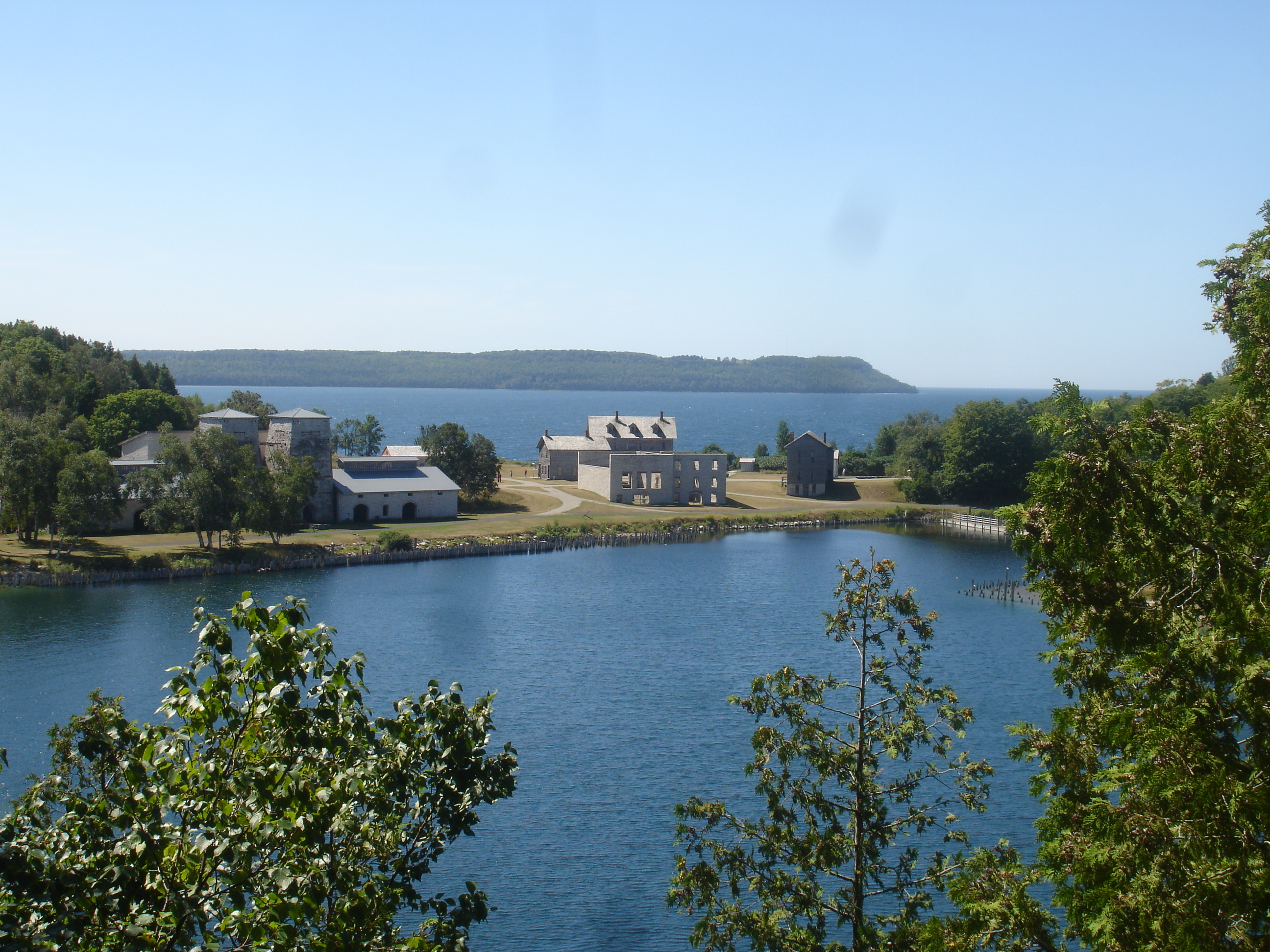
Fayette townsite from above
The overlook shows the relationship between the town, the industrial buildings and the harbor. Credit: Trimalchio.
IMAGE CREDITS & RIGHTS
Fayette townsite from above
The overlook shows the relationship between the town, the industrial buildings and the harbor. Credit: Trimalchio.
PHOTO CREDIT
Trimalchio
LICENSE
CC BY-SA 4.0
CHANGES
None
The overlook shows the relationship between the town, the industrial buildings and the harbor. Credit: Trimalchio.
IMAGE INFORMATION & RIGHTS
IMAGE TITLE
Fayette townsite from above
CAPTION
The overlook shows the relationship between the town, the industrial buildings and the harbor. Credit: Trimalchio.
PHOTO CREDIT
Trimalchio
LICENSE
CC BY-SA 4.0
CHANGES
None
The overlook shows the relationship between the town, the industrial buildings and the harbor. Credit: Trimalchio.
X-UMED
01
/ 04
Fayette and the Iron-Smelting Company Town
Limestone kiln
The lime kiln illustrates a separate use of the area’s carbonate rock. Credit: Susan Schmitt.
IMAGE CREDITS & RIGHTS
Limestone kiln
The lime kiln illustrates a separate use of the area’s carbonate rock. Credit: Susan Schmitt.
PHOTO CREDIT
Susan Schmitt
LICENSE
CC BY-SA 3.0
CHANGES
None
The lime kiln illustrates a separate use of the area’s carbonate rock. Credit: Susan Schmitt.
IMAGE INFORMATION & RIGHTS
IMAGE TITLE
Limestone kiln
CAPTION
The lime kiln illustrates a separate use of the area’s carbonate rock. Credit: Susan Schmitt.
PHOTO CREDIT
Susan Schmitt
LICENSE
CC BY-SA 3.0
CHANGES
None
The lime kiln illustrates a separate use of the area’s carbonate rock. Credit: Susan Schmitt.
X-UMED
01
/ 04
Fayette and the Iron-Smelting Company Town
Shelton House
The Shelton House is a surviving reminder that the town needed lodging as well as industrial buildings. Credit: Susan Schmitt.
IMAGE CREDITS & RIGHTS
Shelton House
The Shelton House is a surviving reminder that the town needed lodging as well as industrial buildings. Credit: Susan Schmitt.
PHOTO CREDIT
Susan Schmitt
LICENSE
CC BY-SA 3.0
CHANGES
None
The Shelton House is a surviving reminder that the town needed lodging as well as industrial buildings. Credit: Susan Schmitt.
IMAGE INFORMATION & RIGHTS
IMAGE TITLE
Shelton House
CAPTION
The Shelton House is a surviving reminder that the town needed lodging as well as industrial buildings. Credit: Susan Schmitt.
PHOTO CREDIT
Susan Schmitt
LICENSE
CC BY-SA 3.0
CHANGES
None
The Shelton House is a surviving reminder that the town needed lodging as well as industrial buildings. Credit: Susan Schmitt.
KEEP EXPLORING
MORE STORIES FROM X-UMED'S DARK ARCHIVE
X-UMED EPISODE/VIDEO
CATEGORIES
◆Historic Places
LOCATION & ACCESS
REGOIN
Northwest
COORDINATES
45.718574
-86.649266
ADDRESS
4785 II Road, Garden, MI 49835
ACCESS
Open to Public
HELP US DIG DEEPER
have a firsthand account, an old photo, or a correction about this place?
SHARE THIS STORY
X
Reddit
Threads
WhatsApp
Email
StumbleUpon
Facebook
SEARCH THE DARK ARCHIVE
⚲
148STORIES
UNEARTHED
UNEARTHED
358MORE STILL
BURIED
BURIED
29% OF THE ARCHIVE UNEARTHED