
 Dark ArchiveItalian Hall Disaster of 1913VIEW ARCHIVE →
LAST UPDATED: NOVEMBER 22, 2026
Bath School Disaster of 1927
On May 18, 1927, an explosion tore through Bath Consolidated School in Clinton County, Michigan. People rushed to help, and a second blast killed and injured people gathered outside. The man responsible was school board member Andrew Kehoe. Michigan Public counts 44 victims, including 38 children. The story continued long after the rubble was cleared. Nurses handled a sudden influx of injured children, families had to return their surviving children to school, and the community raised money to rebuild. A memorial park on the school grounds preserves that history.

REGION
Central
ERA
1900–1929
ENVIRONMENT
HISTORICAL BACKGROUND
One school for a rural community
Bath Consolidated School brought children from the surrounding farming community into one building. The change meant that children who might once have gone to separate rural schools could attend classes in the same place. It also made the school a center of local public life. Decisions made by its board carried consequences for families with children in class as well as for people paying local taxes. Andrew Kehoe lived on a farm and served on that board. His official position is one reason his name belonged in the history of the school before it became inseparable from the attack.
Kehoe was experiencing financial trouble and had complained about taxation. Newspaper coverage quickly made taxes the explanation for what happened. That framing gave a national audience an easy sentence to repeat and overshadowed other parts of his history. In Michigan Public’s interview with Rachel Clark and Arnie Bernstein, Bernstein and Clark discuss a man whose motives remain difficult to reconstruct. A tax complaint and a financial crisis explain what neighbors and reporters knew about his circumstances. They leave open how he came to decide to kill people in his own community.
May 18, 1927
The first explosion tore through a wing during the school day. The damage varied sharply from one classroom to another. In the part of the building where the structure gave way, children and teachers were pinned beneath debris. Elsewhere, adults were still able to help children find ways out. The path described decades later by second grader Vina Fisk went through a break into an adjacent classroom and then through a window. Her account is a reminder that the first task was often figuring out where a living child could physically go.
People from town and the surrounding area came to help. Kehoe’s property was also burning that morning, and his wife Nellie had been killed. At the school, a second explosion killed Kehoe, superintendent Emory Huyck, and others, including a child who had survived the first blast. For families trying to locate their children, the scene now contained people injured at different moments in different places. Early reports could count bodies at one scene or take a figure from a hospital and still leave out people whose injuries would prove fatal.
Bath’s emergency reached Lansing
The rescue did not end when a person was pulled free. Injured children had to reach medical care, and the volume of patients strained the hospitals receiving them. At Sparrow Hospital in Lansing, the work required calling in people who were off duty and finding places for patients wherever there was space. Amie M. Jones’s study of the Bath disaster and its survivors identifies accounts from hospital nurses and staff, and traces how the disaster entered the hospital’s own history. Reading those records puts the focus back on the people who had to manage what the attack left behind. Their work continued after the initial newspaper photographs showed crowds and debris at the school.
Families also needed money and support beyond immediate care. Governor Fred Green created the Bath Relief Fund. U.S. Senator James Couzens contributed to the relief and gave money for a new building. On August 18, 1928, Bath dedicated the James Couzens Agricultural School to the children who would use it. Michigan’s Bath School Disaster marker records the dedication and a children’s penny collection for Carleton W. Angell’s sculpture Girl with a Cat. The collection gave children around Michigan a part in the commemoration. The figure they paid for represents a child absorbed in something ordinary.
STORY & LEGENDS
The tax explanation appeared in the first wave of national coverage. The May 19, 1927, New York Times front page put Kehoe’s protests over taxes in the headline the morning after the disaster, when reporters were still working with an early death toll. That front page shows how quickly one explanation reached readers outside Michigan. In Bath, a different record was taking shape in the accounts of children, teachers and hospital staff. The Amie M. Jones’s study of the disaster and its coverage follows how survivors’ recollections were preserved alongside contemporary reporting and local histories.
ORIGIN STORY
The Bath disaster is often retold as the story of a school board member who killed his neighbors’ children because he was angry about taxes. Andrew Kehoe had objected to taxes and was in financial trouble, which gave reporters a concrete detail to explain an otherwise baffling crime. The shorthand has endured, but it leaves out what the sources cannot settle about his motives. The Michigan Public’s interview with historian Rachel Clark and author Arnie Bernstein revisits that question and the way Kehoe’s position in the community shaped the shock after the attack.
ALTERNATE VERSIONS
What the different totals count
The marker reports 39 children and teachers killed in the school blast. Michigan Public gives 44 victims across the disaster, including 38 children. Other headline totals can differ when they count Kehoe among the dead. Treat the group being counted and the time at which a figure was reported as part of the number itself. The school building, the attack outside, and Nellie Kehoe’s death at the farm belong to the same history, even when a source counts only one scene.
WITNESS ACCOUNTS
Vina Shepherd Fisk, second-grade classroom, May 18, 1927
Fisk told Geneva Wiskemann in a July 28, 2005, Sparrow Hospital Oral History Program interview that Principal Floyd Huggett opened a way from her classroom into the adjoining first-grade room. The children climbed through and escaped through a window at the back of the school. One classmate, Cleo Clayton, died in the second explosion after getting out. The route Fisk remembered is specific enough to show how her group survived. It also makes it possible to understand why a family’s relief at hearing that children had made it out of one room could be brief. Amie M. Jones’s study of the Bath disaster and its survivors documents the interview and the route.
The nurses who received the children
Accounts by nurses Bernice Vowler Smith and Florence Lechlitner Alexander appear in the hospital reminiscences cited by Jones. The hospital phones sounded together as notice arrived that injured children were coming, and a radio appeal called off-duty nurses in to help. This is a firsthand perspective on the receiving end of the disaster, preserved in a retrospective hospital collection. It records the emergency that began in Lansing once people on the ground in Bath started getting children out.
MORBID FACTS
A classmate who got out of the school
Cleo Clayton’s name connects the two scenes. Fisk’s classroom had an escape route, and the children in it were able to get outside. Clayton’s death in the later explosion is evidence of how dangerous the grounds remained after the first rescue began. In accounts that stop with the number killed in the destroyed wing, he disappears into a total. The oral history restores the order of events and the fact that he survived long enough to leave the building.
A pediatric memorial inside a working hospital
Sparrow’s record, as described by Jones, notes that available space ran out and the hospital used hallways for some children. A drive to raise money for the hospital was already underway. After the attack, the idea of a children’s ward as a memorial gathered support and became part of the fundraising. There is a direct connection between the proposed memorial and the crisis the staff had just managed. The hospital needed room to care for children, and Bath had shown what happened when a large group arrived at once.
An anniversary could be a medical event
Jones documents accounts of survivors who remained sensitive to sudden loud sounds decades afterward, including fireworks and thunderstorms. She also recounts a nurse’s memory of a woman who needed care around the annual anniversary after losing a close childhood friend in the attack. That last story comes through a nurse’s recollection and gives one individual example. It shows a kind of harm that hospital admissions in May 1927 and the names on a stone memorial could never fully capture.
Identifying the dead
The school’s collapse meant that finding a child and identifying that child were separate tasks. Photographs and reports were circulating nationwide within days. the May 23, 1927, Roseburg News-Review photo page illustrates how quickly pictures from Bath reached readers far from Michigan. At home, relatives faced a process in which early information could be partial, a child might have been taken to a different place for care, and no public tally could substitute for learning what had happened to a particular person.
CURRENT DAY
The historical marker stands in James Couzens Memorial Park on the school grounds in Bath. The outdoor memorial gives visitors a place to read about the attack and the rebuilding. The 1928 dedication and Angell’s sculpture have their own place in that story. the Clinton County Historical Society’s Bath resource documents the rebuilt school and the community’s interpretation of the disaster. The archive map pin marks the memorial area.
WHAT WE CAN VERIFY
Additional Context
- The date, location, destruction of the school wing, and Kehoe’s responsibility are documented. The differences in published totals make scene and victim scope important. This article uses Michigan Public’s modern count of 44 victims and gives the narrower wording of the state marker where relevant. The accounts from Fisk and the nurses are attributed through Jones’s study and its source notes. Kehoe’s complaints and financial circumstances are documented in the historical literature. The record leaves his complete motive unresolved.
HISTORICAL PHOTO GALLERY
A CLOSER LOOK THROUGH THE YEARS
X-UMED
01
/ 04
Bath School Disaster of 1927
Bath School Disaster of 1927
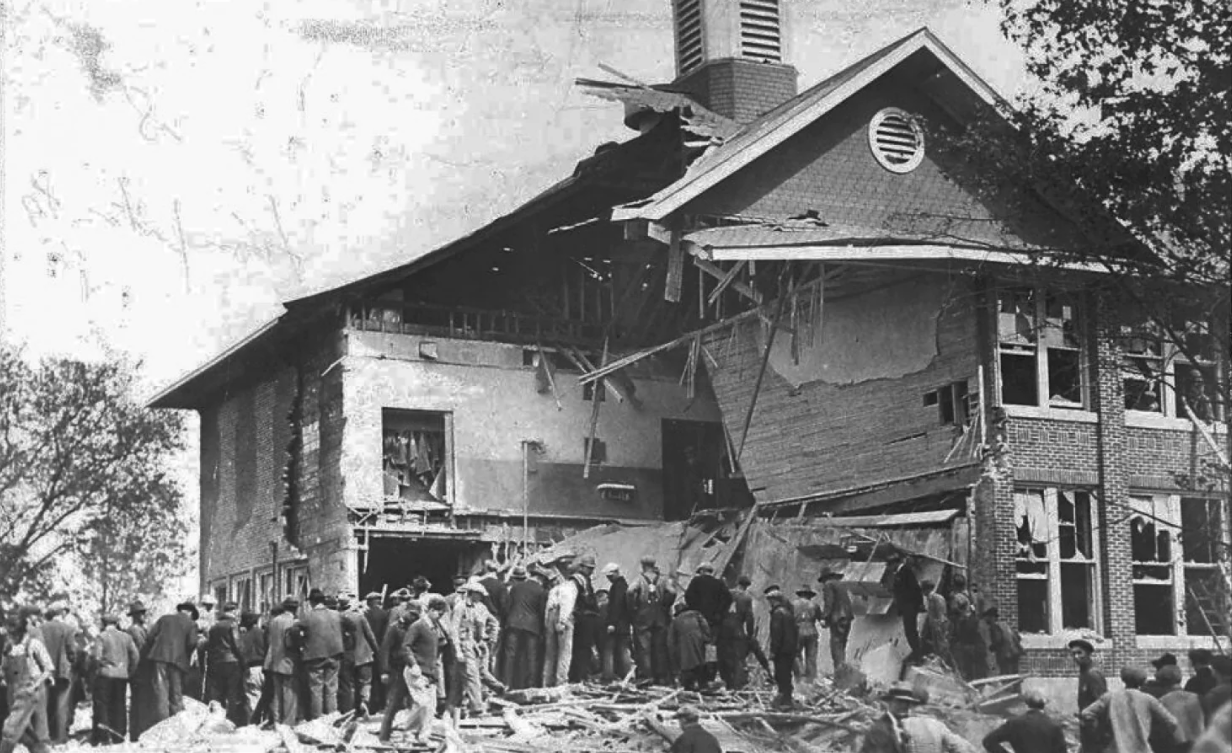
Bath Consolidated School after May 18, 1927
Contemporary press photograph of the damaged Bath Consolidated School. Credit: National Editorial Association/Associated Press, via Wikimedia Commons.

IMAGE CREDITS & RIGHTS
PHOTO CREDIT
National Editorial Association/Associated Press
LICENSE
Public domain (United States)
CHANGES
None
Bath Consolidated School after May 18, 1927
Contemporary press photograph of the damaged Bath Consolidated School. Credit: National Editorial Association/Associated Press, via Wikimedia Commons.
PHOTO CREDIT
National Editorial Association/Associated Press
LICENSE
Public domain (United States)
CHANGES
None
Contemporary press photograph of the damaged Bath Consolidated School. Credit: National Editorial Association/Associated Press, via Wikimedia Commons.
IMAGE INFORMATION & RIGHTS
IMAGE TITLE
Bath Consolidated School after May 18, 1927
CAPTION
Contemporary press photograph of the damaged Bath Consolidated School. Credit: National Editorial Association/Associated Press, via Wikimedia Commons.
PHOTO CREDIT
National Editorial Association/Associated Press
LICENSE
Public domain (United States)
CHANGES
None
Contemporary press photograph of the damaged Bath Consolidated School. Credit: National Editorial Association/Associated Press, via Wikimedia Commons.
KEEP EXPLORING
MORE STORIES FROM X-UMED'S DARK ARCHIVE


X-UMED EPISODE/VIDEO
CATEGORIES
 Disasters & Tragedies
 Abandoned & Forgotten Places
LOCATION & ACCESS
REGOIN
Central
COORDINATES
42.8164
-84.44929
ADDRESS
James Couzens Memorial Park, Main Street near Webster Road, Bath, MI 48808.
ACCESS
Open to Public
HELP US DIG DEEPER
have a firsthand account, an old photo, or a correction about this place?
SHARE THIS STORY
X
Reddit
Threads
WhatsApp
Email
StumbleUpon
Facebook
SEARCH THE DARK ARCHIVE
⚲
148STORIES
UNEARTHED
358MORE STILL
BURIED
29% OF THE ARCHIVE UNEARTHED