
 Dark ArchiveHart Island and New York City’s Potter’s FieldBurial labor, missing ledgers and the fight to visit the gravesVIEW ARCHIVE →
LAST UPDATED: NOVEMBER 18, 2026
Cleveland Balloonfest 1986
On September 27, 1986, United Way turned Cleveland’s Public Square into a giant balloon enclosure and released nearly 1.5 million helium balloons in a world-record attempt. Thousands of volunteers helped create the spectacle, but approaching weather brought balloons down across the city, Burke Lakefront Airport and Lake Erie, where crews were searching for two missing fishermen. The aftermath included debris, disruption and lawsuits. Decades later, participants and historians still disagree over how fairly the day has been remembered, especially the often-repeated claim that the release caused the fishermen’s deaths.

REGION
Northeast
ERA
1970–1989
ENVIRONMENT
Landmark
HISTORICAL BACKGROUND
Why Cleveland wanted the record
Balloonfest was meant to give Cleveland a photograph the rest of the country would remember. The city had spent years living with jokes about its industrial decline and burning river. United Way’s campaign offered a public celebration tied to charitable giving. Plans announced in May 1986 called for two million balloons, surpassing a Disneyland release from the previous year. A record gave the event an easily understood goal, while the charity hoped the spectacle would bring people together. [S4]
Building a temporary balloon factory
The event employed balloon specialist Treb Heining and his company, Balloonart by Treb. Preparations took six months. An enclosure covered with netting occupied Public Square, and roughly 2,500 volunteers, many of them students, spent hours filling balloons. The net had to retain the growing mass until the release. This required a coordinated workforce, a helium supply, a large structure and a plan for a crowded downtown site. [S3]
The eventual launch was smaller than the original two-million target. Ohio Cooperative Living identifies the tally credited in the 1988 Guinness book as 1,429,643. That is the origin of the precise figure frequently repeated today. “Nearly 1.5 million” is a rounded description. The larger two-million figure describes the proposal. [S3]
The release and the weather
On September 27, spectators filled downtown while the organizers watched an approaching storm. The schedule was brought forward, with later accounts placing the release at approximately 1:50 p.m. The net opened and the balloons rose around Terminal Tower. The air and rain then drove many balloons downward instead of carrying them away as anticipated. Wet, still-inflated balloons returned to a city full of roads, people and working infrastructure. [S3]
Where the balloons went
The Encyclopedia of Cleveland History records an interruption at Burke Lakefront Airport, traffic problems and balloons reaching waterways. Its account also reports an injured horse claim that settled and balloon litter on the Ontario shore. Those effects occurred at different places and times. A picture of the release captures only the beginning of an event whose material remained after the crowd went home. [S1]
A search already underway
Bernard Sulzer and Raymond Broderick had gone fishing the previous evening. Defector’s review reports that their boat was found the following day, with indications that it had capsized and righted itself. The men remained missing. Balloons on Lake Erie complicated a search that already had a serious problem to solve. A Coast Guard spokesman told the Plain Dealer that the balloons made the search harder. Broderick’s widow later sued United Way, and the case settled. The underlying court file and settlement terms were not reviewed for this article. [S4]
STORY & LEGENDS
The underlying event is dated to September 27, 1986. The later disaster narrative grew through anniversary reporting and reused television footage. The event and the interpretation therefore have different chronologies. Newspaper photographs can establish where balloons were visible. A later participant interview can establish what that person remembers. Neither automatically resolves a disputed legal or medical cause of death.
ORIGIN STORY
How the “balloon disaster” story developed
Balloonfest’s modern reputation often compresses the launch, falling debris, rescue search and lawsuits into one continuous catastrophe. Ideastream’s 2026 reporting complicates that memory. Historian Mark Souther described the event’s initial reception as largely positive. Some people who had attended remembered an impressive day of civic cooperation even while acknowledging the aftermath. Different participants experienced different parts of the event, which helps explain the conflicting recollections. [S5]
The familiar short documentary also shaped the public record. Nathan Truesdell’s Balloonfest uses archival news footage from the release and its aftermath. Full Frame lists it as a six-minute film shown at the 2017 festival. The footage lets viewers see what television audiences were shown, while the editing determines which moments sit beside one another. The film is a record of historical images and a later construction of a narrative. [S8]
A different documentary, The Internet Lied To Us About BalloonFest 1986, was directed by John Pana for Cleveland.com / The Plain Dealer. The Central Great Lakes Emmy nomination list identifies that production. Its title makes the later argument explicit. Balloonfest had become a story about how an old event was retold, as well as a story about the release itself. [S13]
ALTERNATE VERSIONS
The most consequential disagreement concerns the fishermen. The encyclopedia says balloons prevented rescuers from finding them. Souther told Ideastream that the men probably drowned before the release, while agreeing that the balloons impeded the active search. These propositions address different questions. Interference describes the search conditions. Establishing that the release caused a death would require evidence about when the death occurred and whether a rescue remained possible. The reviewed sources do not settle those questions. [S5]
The event also has two competing measures of success. It produced the record-setting spectacle its organizers wanted. Its environmental and operational consequences then became central to its legacy. A person who remembers a joyful release and a person who remembers balloons littering the water can both be describing real parts of the same day.
WITNESS ACCOUNTS
David Shields, volunteer organizer
In Vince Guerrieri’s 2026 oral history, David Shields recalled arriving early and protecting his fingers with tape while tying balloons. He remembered music and a festive atmosphere, followed by the spectacle of the balloons lifting around Terminal Tower. His account explains the physical work behind an image that can make the release look effortless. [S2]
Jennie Jones, event photographer
Jones recalled photographing the event from a helicopter and becoming frightened when the changing wind took the aircraft into the balloons. Her account concerns the flight she was on. It supplies a named participant’s memory of conditions in the air, recorded forty years later. [S2]
Tom Holowach, operations director
Holowach’s account describes the inflation equipment, borrowed milk crates used to mount valves, and the need to repair the net after the previous night’s wind. These mundane details show how much engineering and improvisation supported the spectacle. The recollection also places weather concerns before the moment of release. [S2]
Max Johnson, a spectator leaving downtown
Johnson told Defector that his family encountered balloons coming down while driving home. He remembered motorists stopping to collect them on Interstate 90. This is a specific retrospective observation, rather than an independently established inventory of traffic incidents. [S4]
MORBID FACTS
The loss at the center of the story
The two missing fishermen are easily reduced to the last sentence of a viral account. They were people whose families were already waiting for news before the square released its balloons. The reviewed reporting supports their deaths and describes search disruption. It leaves the exact survival timeline unresolved. Their deaths deserve that level of care, particularly when an account turns a disputed sequence into an apparently certain cause.
A search can become crowded with false targets
A balloon on the surface adds one more object for rescuers to inspect. At this scale, even a small fraction of the release could create thousands of objects in the surrounding area. The difficulty is more concrete than the phrase “balloon disaster” conveys. Crews have to decide which distant marks deserve another look while continuing to search a large body of water. This explains the practical concern described in the historical reporting, without establishing the fate of a particular person.
The damage can continue after the balloon deflates
NOAA explains that a released balloon can snag, settle back down or burst and fall. Once in the water, it can be carried elsewhere. Animals may mistake fragments for food. Ingestion can cause injury or interfere with nutrition, while attached string or ribbon can entangle wildlife. Those mechanisms give a reason to examine debris after the colorful spectacle has ended. They do not supply a count of animals injured during Balloonfest. [S6]
Where the costs land
NOAA’s broader marine-debris guidance includes effects on recreation and tourism as well as wildlife. The party’s organizers and spectators need not be the people who later encounter its remains. Balloonfest’s reported litter on Canadian beaches illustrates that geographical mismatch. A release begins at a marked location, but its material can cross a shoreline or border long after the event is over. [S7]
CURRENT DAY
Public Square remains a ten-acre downtown park. The visitor address is 50 Public Square, Cleveland, OH 44113. The park’s current layout is the result of later redevelopment, so someone standing there today is seeing a place that has changed since 1986. The site still serves as a public gathering space, with events and visitor information provided by its operator. [S10]
The official Public Square website marks the tenth anniversary of its 2016 renovation in 2026. That redevelopment followed a fifteen-month project. The modern park provides a useful setting for understanding where the release began, while the airport and lake search belong to other locations in the event’s geography. [S12]
The surviving historical experience is largely photographic and audiovisual. PBS / POV provides a listing for Truesdell’s short film, while recent anniversary reporting brings participant memories back into the discussion. A viewer can compare what the older footage shows with what later witnesses say they recall. [S9]
The 2026 anniversary also brought a statement from United Way acknowledging that the event had consequences while emphasizing the volunteers who participated. That continued disagreement is part of Balloonfest’s present-day legacy. The story is still being revised as older coverage and later testimony are reconsidered. [S5]
WHAT WE CAN VERIFY
Additional Context
The event and its scale
The launch date, Public Square location, United Way sponsorship and approximate scale are well supported. The frequently cited precise count is 1,429,643, attributed in secondary histories to the 1988 Guinness book. An original record-book scan was not examined in this review. Two million was the larger planned target.
Search interference and responsibility
Historical reporting describes balloons interfering with the search. Later retrospective accounts challenge a direct link between the release and the deaths. A settlement establishes that a dispute was resolved outside court. Its existence alone cannot establish which factual allegations were proved.
Limits of the available record
The sources are strongest on the launch, its visual record and named participant memories. Exact claims about the number of road collisions, the financial balance of the fundraiser, and damages paid require original records. Those figures have therefore been left out. The article also avoids claiming a measured wildlife death toll when the available environmental sources discuss general mechanisms.
What the interviews establish
The named interviews were published in 2023 and 2026. Their dates matter because memories can be affected by later footage and retellings. They are attributable accounts by people describing their involvement, with their retrospective nature stated openly.
SOURCES
S1 · Vinod Sardesai; updated Christopher Roy. Balloonfest, Encyclopedia of Cleveland History. Updated December 14, 2023. Institutional overview. Broad aftermath claims require incident-level checking.
S2 · Vince Guerrieri. Balloonfest ’86: An Oral History. September 13, 2026. Named retrospective interviews. Memories recorded about forty years after the event.
S3 · W. H. Chip Gross. Downdraft. September 1, 2025. Secondary account of logistics, release and reported Guinness tally.
S4 · Vince Guerrieri. Balloonfest Made Cleveland a Laughingstock. Did It Deserve It?. December 11, 2023. Retrospective interviews and review of older reporting. Original court files unreviewed.
S5 · Christian Petrila. Balloonfest 40 Years Later: Shifting Winds, Shifting Perceptions. September 27, 2026. Interviews historian Mark Souther and reproduces a United Way statement.
S6 · NOAA Marine Debris Program. What Goes Up, Must Come Down!. June 26, 2018. General mechanisms of balloon debris harm, without a Balloonfest-specific wildlife count.
S7 · NOAA Marine Debris Program. Why Is Marine Debris a Problem?. Undated, accessed November 18, 2026. General ingestion, entanglement and economic impacts. Does not measure 1986 damage.
S8 · Full Frame Documentary Film Festival. Balloonfest film catalog entry. 2017 festival. Archival-footage film, director and runtime. Catalog lists release year 2016 and festival year 2017.
S9 · PBS / POV. Balloonfest. Accessed November 18, 2026. Public-broadcast film listing and viewing resource.
S10 · Downtown Cleveland / Public Square. About the Park. Accessed November 18, 2026. Current park use and size.
S11 · Destination Cleveland. Cleveland Public Square. Accessed November 18, 2026. Visitor listing gives 50 Public Square, Cleveland, OH 44113.
S12 · Cleveland Public Square. Public Square. Accessed November 18, 2026. Current event information and 2016 redevelopment context.
S13 · National Academy of Television Arts & Sciences, Central Great Lakes Chapter. 2025 Nominees, Documentary — Cultural. April 27, 2025. Independently identifies John Pana and the Cleveland.com documentary title.
HISTORICAL PHOTO GALLERY
A CLOSER LOOK THROUGH THE YEARS
X-UMED
01
/ 04
Cleveland Balloonfest 1986
Cleveland Balloonfest 1986
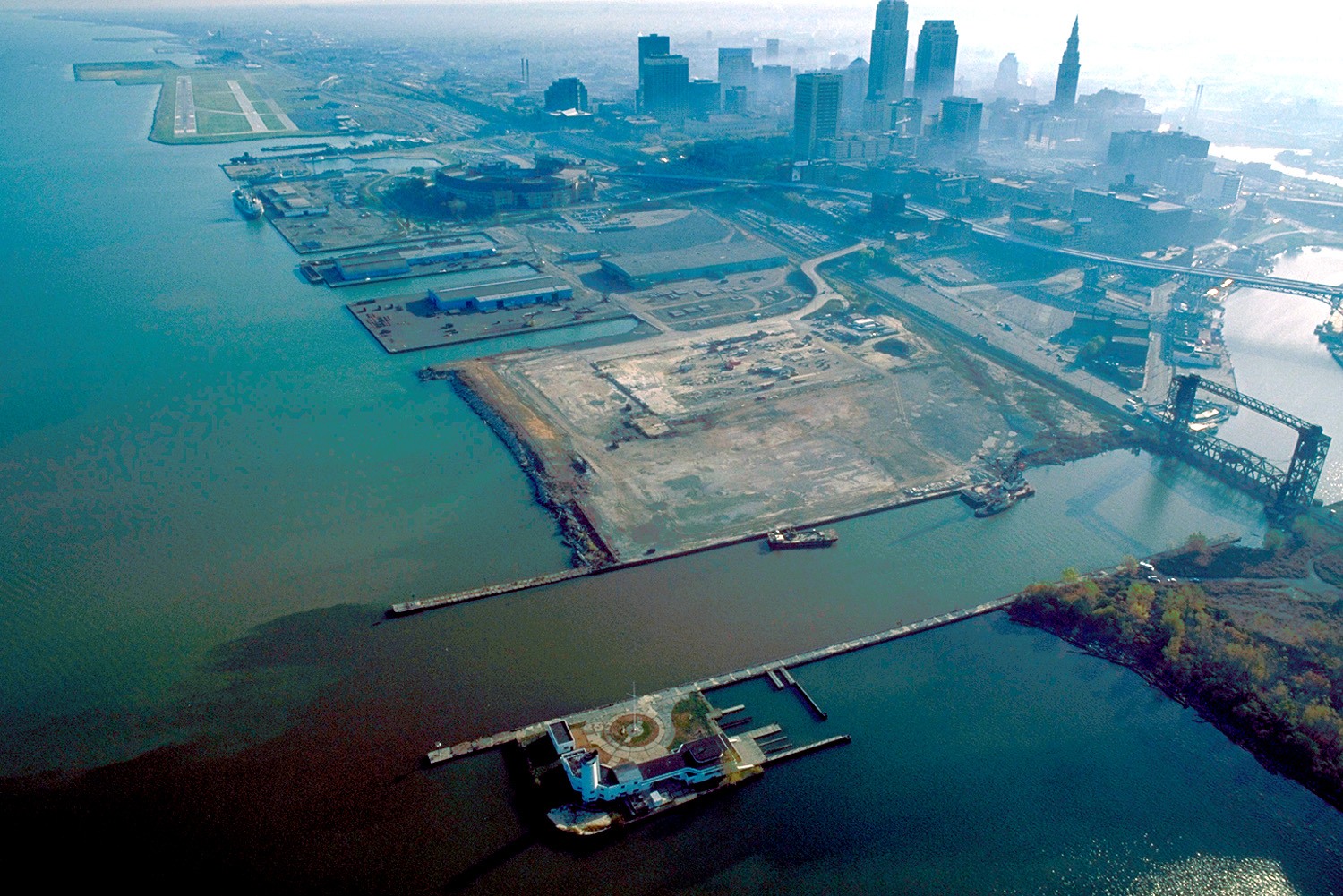
Cleveland lakefront, 1992
A 1992 context photo showing the lakefront and Burke Lakefront Airport. Credit: U.S. Army Corps of Engineers · Public domain in the United States. Original image, unmodified.

IMAGE CREDITS & RIGHTS
PHOTO CREDIT
U.S. Army Corps of Engineers
LICENSE
Public domain in the United States
CHANGES
None
Cleveland lakefront, 1992
A 1992 context photo showing the lakefront and Burke Lakefront Airport. Credit: U.S. Army Corps of Engineers · Public domain in the United States. Original image, unmodified.
PHOTO CREDIT
U.S. Army Corps of Engineers
LICENSE
Public domain in the United States
CHANGES
None
A 1992 context photo showing the lakefront and Burke Lakefront Airport. Credit: U.S. Army Corps of Engineers · Public domain in the United States. Original image, unmodified.
IMAGE INFORMATION & RIGHTS
IMAGE TITLE
Cleveland lakefront, 1992
CAPTION
A 1992 context photo showing the lakefront and Burke Lakefront Airport. Credit: U.S. Army Corps of Engineers · Public domain in the United States. Original image, unmodified.
PHOTO CREDIT
U.S. Army Corps of Engineers
LICENSE
Public domain in the United States
CHANGES
None
A 1992 context photo showing the lakefront and Burke Lakefront Airport. Credit: U.S. Army Corps of Engineers · Public domain in the United States. Original image, unmodified.
KEEP EXPLORING
MORE STORIES FROM X-UMED'S DARK ARCHIVE



X-UMED EPISODE/VIDEO
CATEGORIES
 Dark History
 Folklore
LOCATION & ACCESS
REGOIN
Northeast
COORDINATES
41.49972
-81.69389
ADDRESS
50 Public Square, Cleveland, OH 44113
ACCESS
Open to Public
HELP US DIG DEEPER
have a firsthand account, an old photo, or a correction about this place?
SHARE THIS STORY
X
Reddit
Threads
WhatsApp
Email
StumbleUpon
Facebook
SEARCH THE DARK ARCHIVE
⚲
148STORIES
UNEARTHED
358MORE STILL
BURIED
29% OF THE ARCHIVE UNEARTHED