Abandoned & Forgotten PlacesBath School Disaster of 1927VIEW ARCHIVE →Moonville’s best-known resident is a dead railroad man with a lantern. The town itself has almost disappeared, leaving a tunnel, a hillside cemetery, and stories that disagree about who died and why he keeps coming back. Behind those stories is a small Ohio mining community where the railroad carried people’s livelihoods through the valley and put anyone walking its tracks in danger.
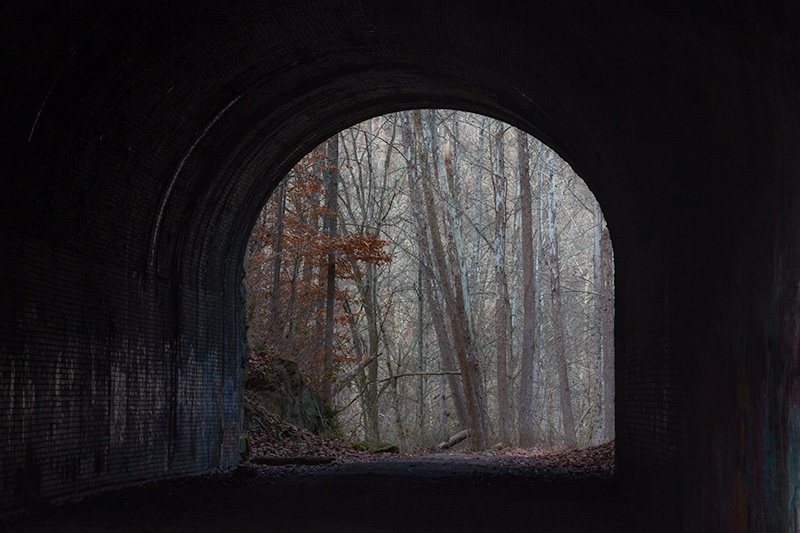
Moonville Tunnel
1800s–Present
Tunnel
In 1856, Samuel Coe allowed the Marietta and Cincinnati Railroad to cross his property. He wanted a route for shipping coal and clay. The arrangement also gave the railroad a useful route through the hills. According to ODNR’s history of Moonville, a community of miners and railroad workers grew around the line and reached approximately 100 residents.
Moonville was small enough that losing work could change the whole community. As nearby mines closed in the early twentieth century, families left. ODNR dates the departure of the last family to 1947. The railway continued after the town had emptied, so the end of Moonville and the end of train service were separate events.
The Moonville Rail Trail brochure dates the tunnel’s original construction to 1856 and its brick repairs to 1903. The tunnel visitors see carries more than one period of railroad work. The National Park Service’s 2021 weekly listing record confirms its addition to the National Register of Historic Places on March 22, 2021.
A March 31, 1859 newspaper clipping describes a brakeman falling from the cars near Cincinnati Furnace two days earlier. Train wheels crushed much of one leg. He was taken to Hamden, where doctors Wolf and Rannells were called to amputate, but his condition was too poor for them to attempt the operation. The report expected him to die. It did not name him, confirm his later death, or place the accident inside Moonville Tunnel. Those limits matter when this man is presented as the tunnel’s positively identified ghost.
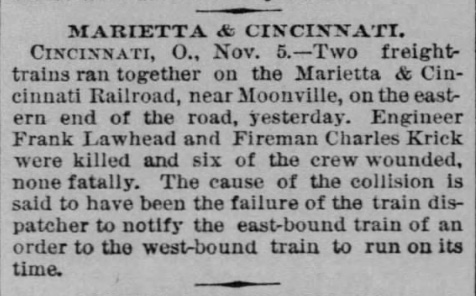
A Chicago Tribune clipping dated November 6, 1880 reports another tragedy near Moonville: two freight trains collided, killing engineer Frank Lawhead and fireman Charles Krick and injuring six crew members. The report blamed a failure to communicate train orders. Later accounts sometimes call the engineer Theodore Lawhead or spell the fireman’s surname differently. The clipping supports what the paper reported; the conflicting names still need reconciliation with railroad and death records.
The hillside cemetery is another surviving part of Moonville, but it should not be treated as a burial ground exclusively for people killed by trains. Quackenbush’s Moonville Cemetery guide describes at least 13 known surviving graves and explains that residents also used other burial places, including Keeton Cemetery, family plots, and Catholic burial grounds in Zaleski. That figure describes known surviving graves, not an established total of everyone buried there.
A 2012 visit documented on Bowling Green State University’s BG Elements blog photographed the graveyard and discussed a military marker for Wellington Coe of the 30th Ohio Infantry. The writer proposed a family identification but did not establish it conclusively. The marker provides a useful reminder that the cemetery preserves individual lives beyond the railway ghost stories.
Moonville is now part of a public rail trail used by walkers, cyclists, and equestrians. The former railroad corridor belongs to the county, while much of the surrounding landscape is Zaleski State Forest. The Vinton County Park District operates the trail, with maintenance provided by the Moonville Rail Trail Association.
The trail brochure records installation of the Neil Shaw Memorial Bridge in 2016, restoring access across the gap left after the old trestle and tracks were removed. Visitors no longer need to reproduce the creek crossings described in older trip reports. Check current notices before traveling. Moonville is also one of the places you can explore through the X-UMED Dark Archive map.
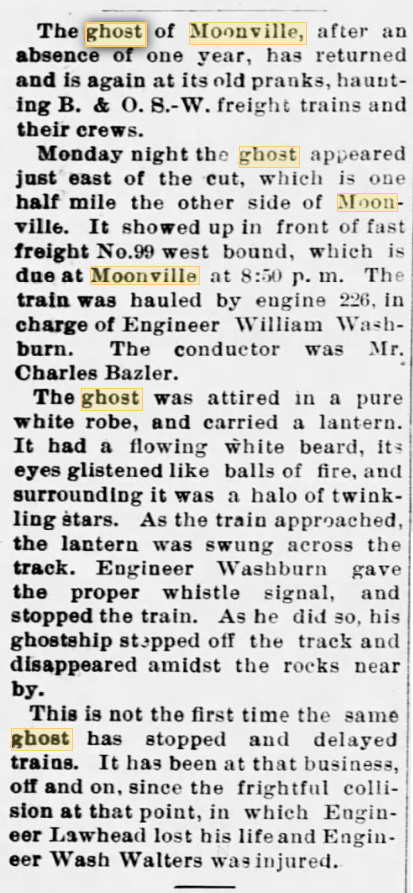
Moonville’s ghost story was circulating while trains still used the line. An old newspaper clipping reproduced by researcher Kit Gentry describes a lantern-bearing figure confronting a westbound freight. It names engineer William Washburn, conductor Charles Bazler, and engine 226. The figure wears white, has a flowing beard and bright eyes, and disappears among the rocks after the train stops.
Gentry identifies the issue as the Chillicothe Daily Gazette, January 23, 1895. He explains that the February 17 date repeated online is mistaken and notes a year misprint on the page itself. This is the earliest dated haunting account located in this research, rather than proof that it was Moonville’s first ghost story. The article already describes a returning ghost.
That early figure is more elaborate than the floating lantern familiar from later accounts. By 1987, a newspaper version reproduced in Gentry’s comparison of the stories had shifted the lantern into Moonville Cemetery. A burial and a midnight appearance had become part of the same tale. The changing setting helps explain why the tunnel, ghosts, and cemetery are better understood together.
The familiar Moonville story starts with a railroad worker trying to stop a train. He raises his lantern, steps too close, and is killed. Afterward, crews see his light along the line. Sometimes a man holds it. Sometimes the lantern swings with nobody underneath it.
Even the local tourism version has its own sequence. In the Ohio Department of Natural Resources account, the dead railroad workers still signal inside the tunnel. The Vinton County visitors bureau tells of a brakeman who wakes to find his train leaving and suffers fatal injuries trying to catch it. These are versions of the legend, rather than matching descriptions of a single verified accident.
Other tellings identify the lantern carrier as an engineer killed in a collision. The engineer is often called Lawhead. A brakeman, by contrast, becomes a much stranger figure: a towering man with fiery eyes, or a headless worker still carrying the light he used in life. The job, appearance, and cause of death change as the story moves between tellers.
The tunnel’s other ghosts have different signatures. The Lavender Lady announces herself with a floral smell. Baldie, remembered as a violent local man, supposedly throws stones at visitors. In Erin Gottsacker’s 2023 Ohio Newsroom report, local folklore author Jannette Quackenbush describes both, along with an engineer’s lantern and an enormous brakeman. Her interview records the stories being told today; it does not establish that the ghosts or the stories’ proposed victims have been identified.
The lantern carrier may be a brakeman, an engineer, a headless man, or simply a light. He may die by falling from a moving train, stepping in front of one, or being caught in a collision. In a cemetery version, he is buried nearby and continues signaling from the graveyard. Those differences are part of the story’s history and should remain visible.
The Lavender Lady is similarly unsettled. A 2019 Valley Reality article by Sophie Kremer discusses three proposed connections: an unnamed woman reportedly killed in 1873, Mary Shea, and Deborah Allen. Those are proposed links made in a later account. None demonstrates that a reported lavender smell belongs to a particular dead woman.
OES also records a young woman supposedly killed while traveling to meet a lover in 1905. A romantic motive makes a memorable story, but the sources reviewed did not independently establish that episode. It should not be merged with an older woman’s death simply because both versions involve the railway.
The recurring reports involve lights, figures near the old line, lavender smells, and stones falling or being thrown. They do not all have the same quality of documentation.
The 1895 newspaper story provides names and train details, making it more traceable than an anonymous visitor’s account. It remains a newspaper report about an alleged apparition. No independently checked statement from either named crew member was recovered for this article.
The Ohio Exploration Society visited on April 6, 2002 and recorded the tunnel’s legends. Its page also mentions a later visitor photograph interpreted as a ghost and a television investigation. A photograph’s existence or a program’s visit establishes that people investigated the reputation; neither establishes an apparition. OES is useful here as a dated account of the site and its folklore.
Some websites repeat an alleged 1993 Athens Messenger interview about students encountering an unheld light. The original article was not recovered in this research, so it is not presented here as a verified interview. No authenticated paranormal recording, photograph, or physical evidence was established by the sources reviewed.
The most disturbing part of the 1859 clipping is what happened after the wheels passed over the brakeman. Doctors had been summoned to remove his damaged leg, but they judged him too debilitated to operate. The newspaper then went to press without reporting a confirmed outcome. The man later made into a named or neatly explained ghost is anonymous in that surviving report.
Moonville residents were buried in several different places. Even if a railway victim’s identity is established, it does not follow that the person lies in Moonville Cemetery. The local cemetery guide also describes missing markers, vandalism, and damage from falling trees. A stone that is gone cannot be used to prove the burial of a legend’s unnamed brakeman.
In the 2023 Ohio Newsroom interview, Quackenbush estimated 27 deaths along this section of tracks. That is her research estimate for a stretch of railway, not a verified count of 27 people killed inside the tunnel. Turning it into an exact tunnel death toll changes the claim and erases the distinction between collisions, trestle accidents, and pedestrians struck elsewhere.
The early haunting report supplied a train number, an engine number, and crew names. Yet the figure at its center has since become several different dead men. Moonville’s folklore preserves surprisingly specific railway details while leaving the identity of its most famous resident unresolved.
Sources reviewed November 6, 2026. Accident and haunting clippings are reproductions, with original-issue verification still pending.

Abandoned & Forgotten PlacesBath School Disaster of 1927VIEW ARCHIVE →
Abandoned & Forgotten PlacesHotel Victory — Rise, Ruin and 1919 FireA grand island resort, a smallpox quarantine and two very different firesVIEW ARCHIVE →
Abandoned & Forgotten PlacesLonz Winery Terrace CollapseThe July 2000 disaster, the island rescue and a landmark’s long recoveryVIEW ARCHIVE →
Abandoned & Forgotten PlacesBallville Dam Collapse — Flood of 1913VIEW ARCHIVE →
Bridges
Abandoned & Forgotten Places
Ghost Stories
Hauntingshave a firsthand account, an old photo, or a correction about this place?