X-UMED | Dark History, Paranormal & Folklore

LAST UPDATED: NOVEMBER 6, 2026
googlemaps
Toledo
The Toledo Mob
Jack Kennedy, the Licavoli Gang, and the Violence Behind the Nightlife

Toledo’s mob war was fought in nightclubs, at traffic lights, and on a summer walk in Point Place. Thomas “Yonnie” Licavoli wanted control of the city’s bootlegging business. Jack Kennedy refused to give it to him. Louise Bell died in an attempt on Kennedy’s life, Kennedy was murdered months later, and the prosecution that followed reached beyond the men with the guns. Even a life sentence failed to end the questions about Licavoli’s money and influence.

Historic view of downtown Toledo’s Summit, Cherry and Jackson Streets with pedestrians, cars and commercial buildings.
REGION

NW Ohio

ERA

1900–1989

ENVIRONMENT

HISTORICAL BACKGROUND

Historic view of downtown Toledo’s Summit, Cherry and Jackson Streets with pedestrians, cars and commercial buildings.
Downtown Toledo, circa 1920 — Charles F. Mensing

Why Toledo was worth fighting over

Toledo sat at the Ohio end of a busy Detroit–Windsor corridor. Roads, cars, boats, and the international border made the region useful to people moving illegal alcohol. Customers did not disappear when the legal trade was restricted; suppliers changed, and so did the risks of doing business. In Joseph Boggs’s 2019 Bowling Green State University study, mobility is central to the story: cars carried shipments, helped gunmen approach targets, and carried bodies across jurisdictional lines. Toledo’s violence belonged to that regional economy, rather than an isolated local feud.

Selling protection from the people making the threats

By the early 1930s, the Detroit-connected Licavoli gang was moving into Toledo’s liquor and gambling business. The attraction was continuing income: customers buying drinks, establishments taking bets, and operators paying to avoid trouble. A protection payment was coercion dressed as a business expense. Someone refusing it could lose much more than a shipment. The distinction matters because the feud is often remembered as two colorful personalities disagreeing, when control of other people’s livelihoods was at stake.

The man Toledo liked better

Kennedy ran the Studio Club at 512 Superior Street. Kenneth Dickson’s history hosted by the Toledo Police Museum describes a socially connected club owner whose customers included prominent Toledoans. He also describes a practical advantage: bulk beer transportation that allowed Kennedy to undercut a rival’s glass price. Kennedy’s appeal and his business methods both challenged Licavoli. His popularity did not make bootlegging lawful, but it helps explain why the public response to his death was so strong.

Louise Bell was killed first

On November 30, 1932, Kennedy and Louise Bell were in a car at Superior and Jackson when gunmen fired into it. Kennedy survived. Bell did not. The local Unholy Toledo history tour identifies her as a manicurist who had come from Kentucky and places their evening at the Paramount Theatre before the shooting. The familiar phrase “Kennedy’s girlfriend” leaves out the person who actually died in that attack. Bell belongs in the central narrative, not in a sentence used only to foreshadow Kennedy’s death. Accounts disagree about her age, so an exact age is not assigned here.

The Point Place killing

Kennedy was killed on July 7, 1933, while walking with Audrey Ralls near the Edgewater Drive grocery store of George Neumeyer. The tour identifies the associated location as 5902 Edgewater Drive. Dickson’s account says a second shopping trip followed the discovery of sour milk, and that Kennedy left his bodyguard behind. Ralls survived after being pushed away. Those ordinary details explain how a guarded man became exposed, but they do not prove that his companion deliberately put him there.

The case did not rest on a nickname

The gunman known as Joseph “Wop English” appears in the court record under Sinatra. The historical nickname contains an anti-Italian slur; it is useful for matching records, not as a description to adopt. In Sinatra v. State, decided May 9, 1934, the appeals court reviewed eyewitness identification, an alibi, conduct after the murder, and firearms evidence. Sinatra denied being the shooter. He said he had been at State Service during the relevant hours. The judges described that establishment as a distributor of punchboards and slot machines. The murder investigation led straight back into the city’s gambling trade.

A conviction, followed by decades of challenges

Licavoli was convicted of murder in Lucas County in 1934, and his conviction was affirmed in 1935. That chronology is stated in the Sixth Circuit’s 1971 opinion in Licavoli v. Maxwell. His later challenges included claims of coerced prosecution testimony, prejudicial publicity, and an insufficiently specific indictment. The federal court upheld the denial of habeas relief. This was not simply a case that ended when the boss went to prison. The fairness and construction of the prosecution continued to be argued long afterward.

Repeal did not erase the business

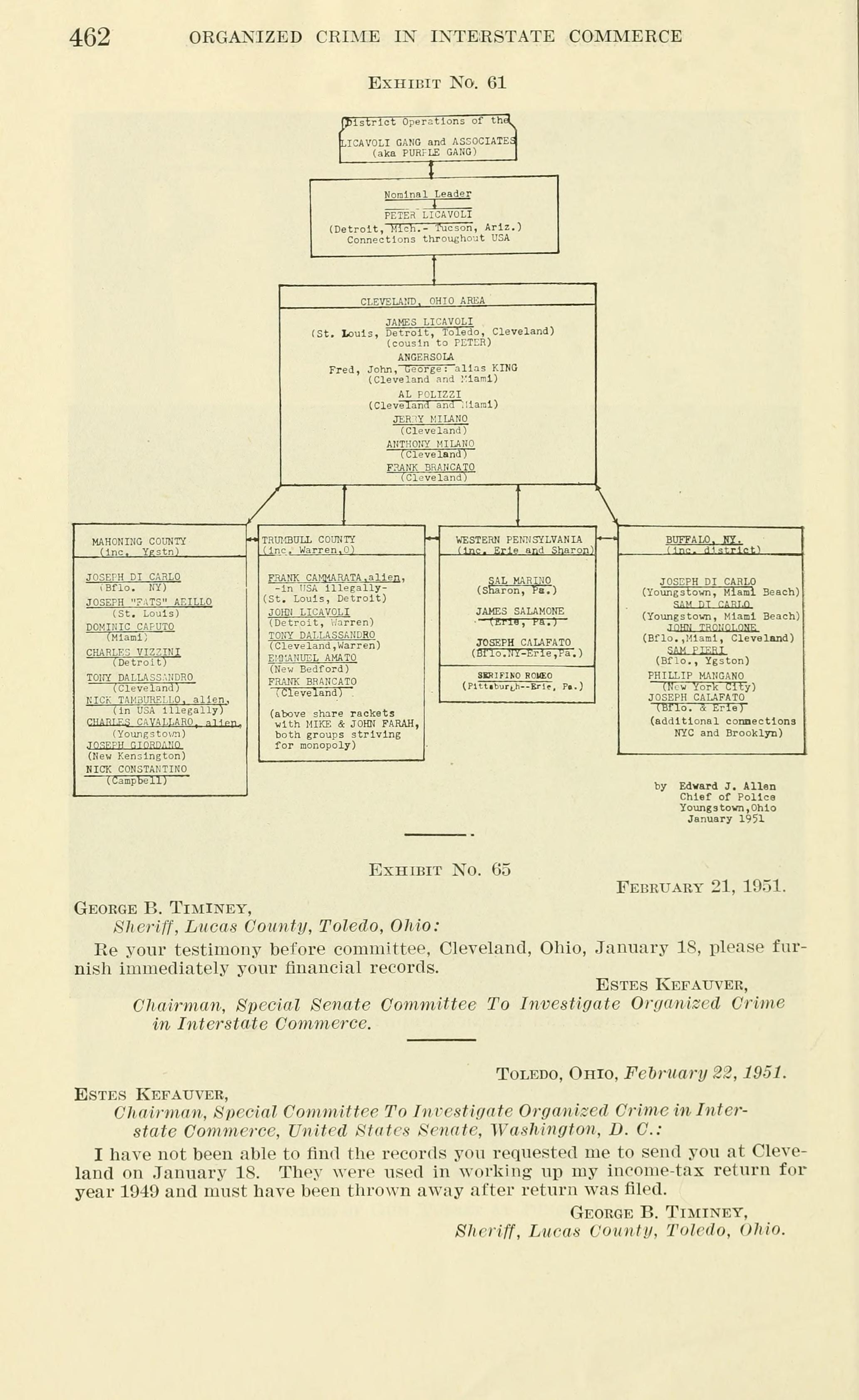
National Prohibition ended in December 1933, after Kennedy’s murder. Gambling and extortion did not depend on keeping alcohol illegal. A particularly revealing later document is James Licavoli’s January 1951 Senate testimony. James identified Yonnie and Pete as first cousins, acknowledged a Toledo extortion plea in 1945, and said he had been paroled in 1946. It is direct evidence that the regional criminal history extended beyond the early-1930s beer war. James’s testimony belongs to James; it must not be silently added to Yonnie’s biography.

Current day: a history spread across a city

There is no single public “mob headquarters” encompassing this story. Superior and Jackson, the former club address, and Edgewater Drive refer to different episodes. Private residences associated with participants remain private. The Toledo Police Museum at 2201 Kenwood Boulevard offers a public starting point; its website currently lists free Saturday opening from 10 a.m. to 4 p.m. The map pin uses that visitor location rather than suggesting a residential murder site is an attraction. For another part of Toledo’s surviving past, the Oliver House story follows a different building and history, without implying it belonged to this gang.

STORY & LEGENDS

This entry concerns a documented criminal conflict and the stories that grew around it. Contemporary legal proceedings provide firmer ground than later gangster anecdotes. The 1934 Sinatra opinion is a dated early source for the evidence presented over Kennedy’s death; the 1951 Senate record shows how related names and Toledo activities remained under scrutiny. Later books, museum interpretation, tours, and television helped shape today’s “Unholy Toledo” narrative. Their agreement may reflect shared research rather than independent confirmation. No haunting account is added simply because the history involves violent deaths.

ORIGIN STORY

How Kennedy became the city’s hero

A murdered bootlegger can become easier to remember as a defender than as a businessman working outside the law. Kennedy’s resistance to Licavoli gave Toledo a sympathetic figure in a frightening conflict. The nightclub stories, personal generosity, and refusal to back down helped that image endure. The historical problem begins when affection becomes evidence: being well liked does not settle every allegation about his conduct, and disliking his killers does not make every prosecution method sound.

The woman who survived became a suspect in the retelling

WGTE’s The Prohibition Chronicles, released in 2018 includes speculation that Audrey Ralls might have helped arrange the killing. The program also makes clear that the question remains unsettled. Survival, a second walk, or difficulty identifying attackers does not establish participation in a murder. The evidence reviewed here does not justify calling Ralls an accomplice. Her place in the story is as the companion present during the attack, with later suspicions identified as suspicions.

ALTERNATE VERSIONS

The phrase “Toledo mob” can make several decades of crime sound like one organization. This entry centers on the Licavoli–Kennedy struggle. A shared surname, ethnicity, neighborhood or acquaintance does not establish gang membership, and later gambling cases need their own histories.

WITNESS ACCOUNTS

What the eyewitness evidence actually involved

The Sinatra appellate opinion describes two eyewitnesses identifying him, alongside witnesses supporting his alibi. The judges acknowledged conflicts within the evidence. They considered the identification and alibi together with his own testimony and subsequent movements, rather than pretending that a witness’s confidence settled the whole case. Their decision left the conviction standing; the short published opinion does not reproduce every question, lighting condition, or original witness statement.

Ralls’s description and its limits

Dickson reproduces Ralls’s description of being shoved away before hearing shots at close range. It is a later publication carrying an attributed account, not a newly located recording or an interview conducted for this article. She is important because she was present, but presence alone cannot resolve the identities and responsibilities of everyone involved. Likewise, later family recollections in the documentary help preserve local memory without becoming fresh eyewitness testimony to a 1933 event.

MORBID FACTS

The accused gunman was found under a bed

The most unlikely detail is in the court opinion itself. After an initial detention and release, Sinatra went to Buffalo and later Akron. The judges describe his September 28 arrest under a bed in a room he was occupying with a woman he had met only hours earlier. He called himself a traveling clothing salesman, and clothing samples were found in his car. The court did not treat the samples as a complete answer to his movements. His effort to avoid the police was evidence the jury could consider alongside the murder testimony.

His own account carried the murder news to Licavoli

Sinatra testified that he obtained a Toledo newspaper around midnight naming him as a suspect. He then drove to Detroit, attended the funeral connected with Licavoli’s family, and gave the paper to Yonnie. That sequence appears in the appellate account, rather than merely in a story about underworld gossip. It helps explain why investigators cared about where the suspects went and whom they contacted after the shooting, even when those movements did not themselves prove who fired.

The bullets were evidence about mercy as well as identity

Sinatra’s defense objected to extensive shooting evidence after conceding that Kennedy had been killed, while denying Sinatra’s involvement. The court explained why the state could still present the bullet wounds, recovered guns, and links between bullets and weapons: the circumstances mattered to the degree of the crime and whether the jury should recommend mercy. A detail about the body could therefore affect the punishment as well as help reconstruct the attack. That is a more specific part of the case than an unsupported description of a victim being “riddled.”

Children found a weapon in the river area

The local tour describes boys finding a .38 near the Ottawa River at 119th Street, with a .45 located nearby in a separate recovery. The court independently discusses a recovered revolver and automatic pistol and testimony linking bullets from Kennedy’s body to the guns. The neighborhood discovery story and the courtroom evidence answer different questions: one describes how a weapon reportedly surfaced; the other establishes that firearms evidence was part of the prosecution. No original police property receipt or laboratory worksheet was inspected here.

Prison did not necessarily sever a boss’s influence

A May 2, 1969 TIME report described controversy over Governor James Rhodes’s commutation of Yonnie’s life sentence. It reported earlier prison favoritism, unauthorized visitors, and allegations that he continued to profit from rackets while incarcerated. Commutation made parole possible; it was not an acquittal. The article also explicitly declined to claim that Rhodes had accepted a bribe. It is evidence of a contemporary scandal and its allegations, not permission to upgrade every allegation into a proven transaction.

A Senate hearing preserved the family distinctions

In 1951, James Licavoli said he had gone from Detroit to Toledo around 1930 or 1931 and returned around 1933 or 1934. He denied gambling involvement there and gave evasive answers about what he had done. The same testimony acknowledged his later extortion plea. These answers are revealing precisely because they coexist in one record. They should be read as a witness’s statements under questioning, not as a complete or necessarily candid explanation of the criminal network. The hearing also prevents the different men named Licavoli from being collapsed into one almost fictional super-gangster.

CURRENT DAY

WHAT WE CAN VERIFY

Confirmed History

  • Contemporary court opinions document the Kennedy murder prosecution and Licavoli conviction.

Unverified Claims

  • Audrey Ralls’s participation in a setup and a complete fourteen-murder attribution are not established here.

Important

  • Witness disputes and allegations of coercion appear in the legal record; appeals left the convictions standing.

HISTORICAL PHOTO GALLERY

A CLOSER LOOK THROUGH THE YEARS

KEEP EXPLORING

MORE STORIES FROM X-UMED'S DARK ARCHIVE

X-UMED EPISODE/VIDEO

Leave a Reply

CATEGORIES

Dark History
googlemaps

LOCATION & ACCESS

googlemaps
Toledo
REGOIN
NW Ohio
COORDINATES
41.669546
-83.596017
ADDRESS
Multiple historical sites in downtown Toledo and Point Place. Map pin is the public Toledo Police Museum, 2201 Kenwood Boulevard, Toledo, Ohio 43606; it is not a murder-scene pin.
ACCESS
Open to Public
LOCATION ON MAP
HELP US DIG DEEPER

have a firsthand account, an old photo, or a correction about this place?

SHARE THIS STORY
X
Reddit
Threads
WhatsApp
Email
StumbleUpon
Facebook
SEARCH THE DARK ARCHIVE
148STORIES
UNEARTHED
358MORE STILL
BURIED
29% OF THE ARCHIVE UNEARTHED