X-UMED | Dark History, Paranormal & Folklore

LAST UPDATED: NOVEMBER 7, 2026
googlemaps
Youngstown
Mill Creek Park, Home Cemetery, and the Stories That Became Tangled
A Family Burial Ground, a Witch’s Cave, and Two Places Elsewhere

A real family cemetery lies beside the history of Mill Creek Park, but its documented names are Kyle-Price and Home Cemetery. The Buechner haunting belongs to a women’s residence hall near Youngstown State University. The Pool gravestones belong to Highbanks near Columbus. Each has a worthwhile story. Joining them into one haunted cemetery creates a place the evidence does not support.

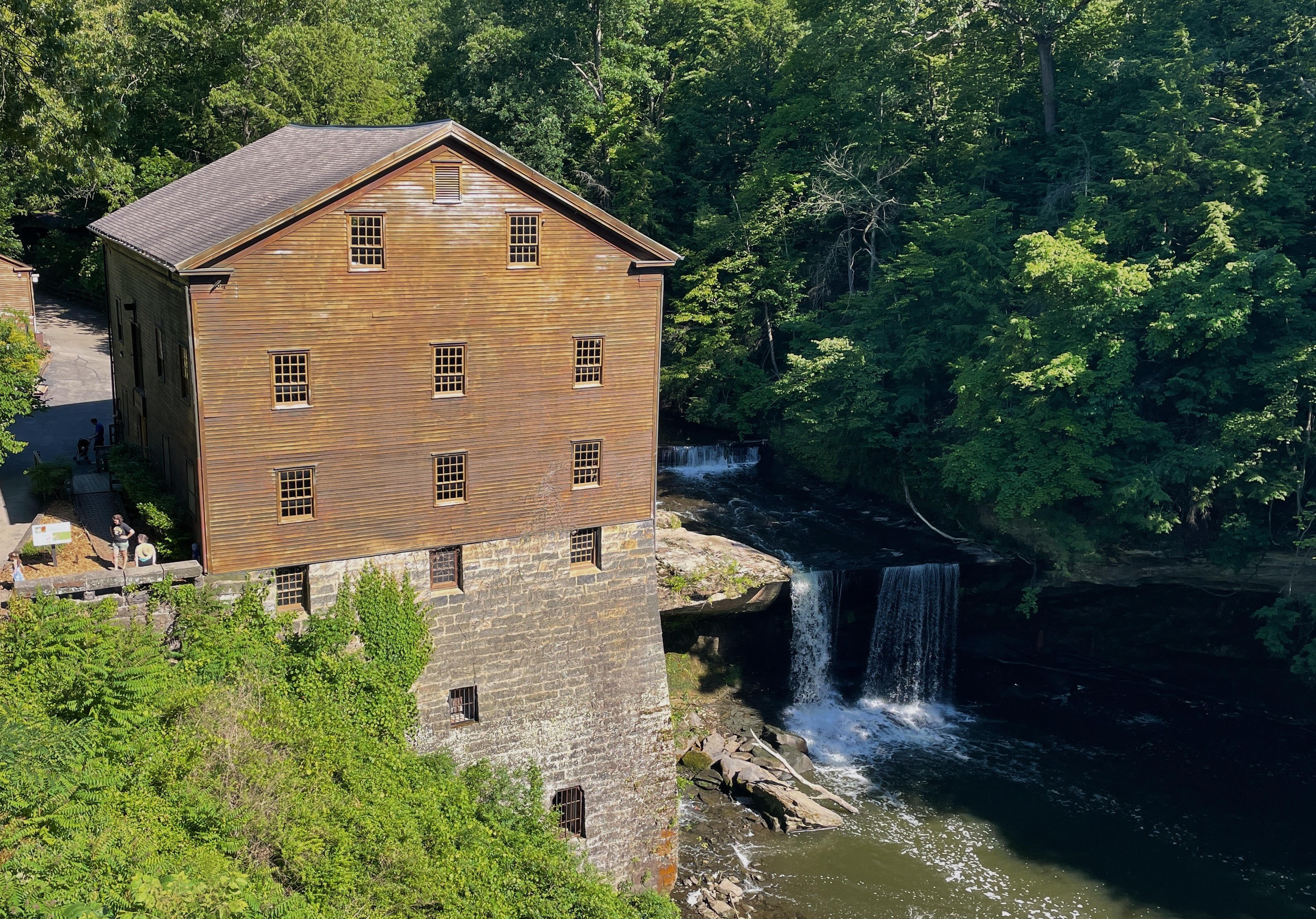
Historic postcard of Pioneer Pavilion beside Mill Creek in Youngstown
REGION

NE Ohio

ERA

1800s–Present

ENVIRONMENT

Cemetery

HISTORICAL BACKGROUND

Historic postcard of Pioneer Pavilion beside Mill Creek in Youngstown
Pioneer Pavilion, Mill Creek Park, 1910 postcard

A death near the family home

The Ohio historical marker for the Kyle-McCollum House dates the burial ground’s beginning to 1824. Thomas Kyle, a son of Joshua and Mary Kyle, died following a fall and was buried near the homestead. Later family burials made that single grave a continuing cemetery. Joshua and Mary, their daughter Hannah, and Hannah’s husband Ira McCollum are among those named in the marker’s account. The cemetery tells a family history that began before a public park occupied the valley.

The house and the landscape changed around the graves

The marker connects the homestead to the family land later sold to help create Mill Creek Park. The house, the burial ground, and the public landscape are related places with different uses. That relationship does not establish Buechner or Pool as alternate cemetery names.

The park was made, not simply discovered

Volney Rogers helped establish the park district in 1891. The National Park Service’s landscape history describes Charles Eliot advising on its drives and trails, followed by Warren Manning and later Olmsted Brothers work. What now feels like a wooded retreat was also a designed public landscape. Routes, recreation areas, quarry sites, and viewpoints changed over time. A story set on today’s trail should not assume that the same route or view existed a century earlier.

The industrial valley beneath the picnic ground

The park’s historic-sites account describes Pioneer Pavilion beginning in 1821 as a wool-carding and fulling mill, later serving the nearby furnace and eventually becoming a gathering place. It also identifies the Old Log Cabin as a former medical office associated with Dr. Timothy Woodbridge. These histories explain why ordinary park features carry older uses. A former medical office does not establish surgical deaths there, and a furnace ruin does not establish concealed burials. The actual industrial and medical uses are interesting enough without adding a catastrophe.

Where Buechner belongs

Buechner Hall opened in the twentieth century near Youngstown’s college campus. It is a women’s residence, not a cemetery or a Mill Creek Park building. Its own description identifies the private nonprofit Lucy R. Buechner Corporation and the bequest supporting residents. The distinction changes both the story and access: a housing facility has people living in it. A ghost account associated with its corridors cannot be moved to a wooded graveyard just because the same city appears in the address.

Where the Pool stones belong

The Central Ohio Metro Parks account of the Pool family places the stones at Highbanks. Joseph and Sally Pool came from New York in 1812 and farmed in what became the park area. The markers were discovered stacked south of the park and relocated in 1981. Their present arrangement is a recreated cemetery; the actual graves have not been located. This is an unusual story of memorial rescue in its own right. It takes place near Columbus, not in Youngstown’s Mill Creek Park.

Current day: follow the right name to the right place

For Mill Creek Park, use official trail information and signs. For the Kyle family, the historical marker on McCollum Road gives a reliable starting point for understanding the homestead. The map reference supplied here is the marker, not a confirmed cemetery gate. Do not approach the private house as though it is a museum. Buechner Hall remains private accommodation. Highbanks has its own map, staff, and visitor rules. The three locations require separate journeys and should not share one cemetery pin.

STORY & LEGENDS

The combined “Buechner / Pool Cemetery” name was not substantiated by the institutional and cemetery sources searched. That does not prove nobody has ever used it informally; it means it cannot be treated as an established location name. The independently traceable strands are Home/Kyle-Price Cemetery, Mill Creek’s Witch’s Cave, Buechner Hall, and Highbanks’ relocated Pool stones. Their source histories should be kept separate. A 2001 cave-hike notice and a 2019 named-witness residence-hall report are dated leads, not the first-ever versions of either tradition.

ORIGIN STORY

Witch’s Cave is a park legend, not a cemetery name

The Witch’s Cave area has a documented place in local park programming. A September 30, 2001 Vindicator calendar advertised a hike connecting the cave, witch-hazel, folklore, and natural history. More recently, the park’s October 25, 2026 geology walk explicitly called the cave story an urban legend. That wording matters. A place can have a durable local name and story without a documented witch, execution, or hidden grave behind it.

Lady Buechner is a different tradition

A dated 2019 Jambar article records the “Lady Buechner” tradition at the residence hall. It connects the ghost identity to Lucy Buechner, whose bequest funded the institution, and to an image of her wearing black. The building was constructed after her death. This is a haunting story attached to a benefactor’s later memorial, not evidence that she lived or died in those rooms. The legend should remain attached to its actual setting.

ALTERNATE VERSIONS

The cemetery name and exact location emphasized in paranormal retellings vary, and some stories blend the cemetery with general Mill Creek Park haunting claims.

WITNESS ACCOUNTS

Named people, and a secondhand account

In Frances Clause’s 2019 Jambar report, resident Geena Badalamenti described moving doorknobs and a shadowy reflection. Former resident Christina Aviles described feeling followed. Amanda Bertilacci relayed a friend’s report involving a dark mist and a laptop display. The last account is secondhand within the article. These reports document what people said they experienced at Buechner Hall. They do not document activity at Home Cemetery or prove Lucy caused the events.

No comparably traceable set of named encounters was established for a Buechner-Pool cemetery. The park’s cave walks document interest in a legend, rather than an investigation establishing supernatural activity. Reflections, building sounds, electronics, lighting, and expectations are circumstances to examine if an original account becomes available. They are not ready-made verdicts about an event whose conditions are unknown.

MORBID FACTS

A cemetery can survive while its original setting disappears

The Kyle burial ground began with a family death, before the park. The surrounding estate later changed hands and parts of the working landscape vanished beneath a lake. A small cemetery can therefore preserve a relationship to a household more clearly than the surrounding terrain does. It should not be treated as an abandoned prop simply because modern recreation has become the valley’s better-known use.

At Highbanks, the stones do not identify bodies beneath them

The Pool display exposes an important cemetery assumption. Authentic gravestones can stand in a historically meaningful arrangement while the actual remains are elsewhere and unlocated. Moving a stone does not establish that a coffin or skeleton moved with it. The park explicitly distinguishes its recreated plot from the unknown burial locations. A photograph of that enclosure therefore cannot prove a particular person lies under the visible marker.

One family’s markers record children as well as adults

The photographed Pool inscriptions include Sally, Joseph, a young son named Ebenezer, and an infant son without dates. Ebenezer’s marker gives his death in July 1820 at six years old. These are concrete memorial details. They do not establish an epidemic, poisoning, or a single accident. Nearby death dates often invite a dramatic explanation; the explanation still needs records of its own.

The park’s founder is buried somewhere else

The official history of Volney Rogers says he died in December 1919 after illness following a western trip and is buried at Tod Cemetery. His statue and the park carrying his legacy are not his grave. That is another reason to separate commemorative places from burial locations. A name strongly associated with a landscape can make a mistaken burial story sound plausible.

A generous benefactor became a spectral resident

Lucy’s will supported housing she did not live to see built. The real continuation of her influence is the residence itself and the corporation maintaining it. The later ghost tradition makes that lasting connection literal by placing her in its hallways. It is an understandable transformation in storytelling, but it should not replace the woman’s documented philanthropy with a fictional death in the building.

CURRENT DAY

WHAT WE CAN VERIFY

Confirmed History

  • Home/Kyle-Price Cemetery, Buechner Hall, and the Pool stones are distinct subjects and places.

Unverified Claims

  • The reviewed ghost reports do not establish supernatural activity or a shared haunted cemetery.

Important

  • The existing combined cemetery name was not substantiated; the article corrects the conflation.

HISTORICAL PHOTO GALLERY

A CLOSER LOOK THROUGH THE YEARS

KEEP EXPLORING

MORE STORIES FROM X-UMED'S DARK ARCHIVE

X-UMED EPISODE/VIDEO

Leave a Reply

CATEGORIES

Cemeteries & Graves
Dark History

Ghosts & Hauntings

Witches & Witch Legends
googlemaps

LOCATION & ACCESS

googlemaps
Youngstown
REGOIN
NE Ohio
COORDINATES
41.090008
-80.677639
ADDRESS
Kyle-McCollum historical marker, 1458 McCollum Road, Youngstown, Ohio 44509. Pin references the marker, not an entrance to Home Cemetery. Buechner Hall and Highbanks are separate locations.
ACCESS
Open to Public
LOCATION ON MAP
HELP US DIG DEEPER

have a firsthand account, an old photo, or a correction about this place?

SHARE THIS STORY
X
Reddit
Threads
WhatsApp
Email
StumbleUpon
Facebook
SEARCH THE DARK ARCHIVE
148STORIES
UNEARTHED
358MORE STILL
BURIED
29% OF THE ARCHIVE UNEARTHED